This is about my journey to pass the Platform App Builder certification exam. Yours will probably vary, and I hope this article is part of it.
For me, Platform App Builder is my third Salesforce certification. I passed the Administrator exam in 2018 and the Platform Developer I certification in 2019. 2020 I was too focused on expanding the Logic20/20 Salesforce Capabilities to study for an exam.
I have admitted in the past, and will repeat for clarity here, that much of my blogging is driven by having searchable notes on how I accomplished something so that when I need to do it again I can readily remind myself of what worked. My certification posts show a pattern that is working: Work with the tool, takes a course, take a diverse set of practice exams, then do it for real. Patterns are great for planning, though the devil is in the details, and I will get to those in just a moment.
Before getting to the good stuff, it is important to note that there is a key part of the pattern that is missing from those previous post, perhaps the most critical aspect: a genuine interest working with the tool that I want to be certified in. The value of this is clear from my first certification for the WebLogic Portal (RiP). I didn’t study for it at all, I just took the exam and passed (barely). I took the exam because it was required by the company that acquired the product. I had passionately worked with it for several years, and expected passing would be easy. It wasn’t, because certification exams are more about knowing things than doing things. Doing them does help to know them, just not as much as I would have thought. Anyway, it is that interest in doing that motivates me to acquire the knowing necessary for certification.
As a mentor, I frequently hear the same concern from people that are learning something new outside of their day-to-day work: It can be difficult remembering things by only reading or hearing about them. Learning exercises are often not enough as they are structured for success and the simple step-by-step instructions become a validation in following instructions rather than an acquisition of the knowledge necessary to perform the task. One thing I had done to rapidly accelerate my abilities in WebLogic Portal was to spend an hour each morning reading the community posts and answering questions. Not only questions I already knew the answer to, but also the ones I did not, by figuring it out, validating it, and then responding. Years later, I applied this technique again after becoming an Informatica Cloud Master. As many people know, solving real-world problems helps to lock in the learning. What I learned with WebLogic and Informatica is that there a plenty of real-world problems to solve beyond my own daily work.
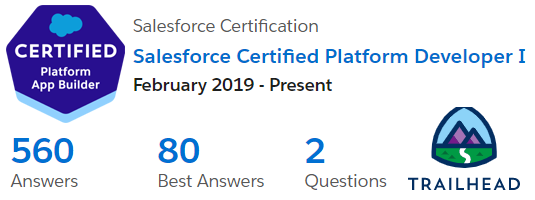
In the case of Salesforce certifications, I can honestly say the best study technique was getting in to the Top 10 on the Trailhead Community Answers Leaderboard.
Beyond the community participation, the App Builder certification was the first one where I did not have frequent “ah ha!” moments while taking the trainings. The first (and last…I repeated it a day before the exam) training I took was the free one Salesforce offers on their Certification Days page. It is certainly worth taking for the pattern tips of how the exam questions are structured, such as (paraphrasing) “If there is a choice that suggests anything other than a declarative approach, it isn’t that one” and “Watch out for choices with multiple parts where most are correct. They must all be correct.”
I’m still a big fan of Udemy. I am also frugal, so I enrolled in Mike Wheeler’s Salesforce Platform App Builder Certification Course during one of the frequent sales. It’s a good course, though a lot of material is dated and it gets a little annoying to hear him complain about features that have long since been improved. The course does not include a practice exam, but I have found that courses that do have few more than the number of questions on the actual exam. The problem with that, is that there are way more questions available, and each exam consists of a random set of questions (within the ratios as described in the official study guide).
The App Builder Certification is one of the more popular ones. I think this is partly attributed to it being in the “Developer” category of certifications while requiring no knowledge of coding, and partly because Salesforce heavily emphasizes that coding isn’t necessary and should be avoided. Having been a consultant for a software vendor, I understand the value of declarative solutions because it is safer for regular vendor updates. I will also say that knowing nothing about the implications of technical choices can be a huge disadvantage even if everything is done declaratively. But I digress…
The practice exam package I went with from Udemy was Salesforce App Builder Practice Test [325 Questions] WINTER’22. There is great diversity in the questions, though there are several that are the same general question with subtle differences. They are spread through 5 timed tests. I didn’t do the actual math, but I think that while the total of all questions are in the correct exam ratio (23% Fundamentals, 17% UI, 22% Data Modeling, 28% Logic & Automation and 10% Deployment), I believe only 2 of the sets are correctly spread across topics. For me, reporting is a weak other (I generally delegate that work), and I found myself failing some of the practices where reporting questions were too heavily waited.
The value of practice exams is not memorizing the answers (don’t, because they change to avoid just that). The value is in learning weak points and shoring them up with some reading or Traihead modules.
As I mentioned, the App Builder is a popular certification, and there are a lot of other offerings on Udemy for practice exams. I made the mistake of buying one several months before using it and could not get a refund. I did get a refund on another that looked really good in the description but was outdated and contained several answers I knew were wrong. There are also several free video dumps on YouTube, and I found that many were also inaccurate, besides being the wrong medium for this type of studying (at least for me).
So, to summarize:
- Get interested in what you are studying for
- Attend one of the free Salesforce prep trainings (you also get a discount on your exam with the training!)
- If you don’t get to build apps often at work, go help people on Trailhead to gain practical experience
- Pick a good training course on Udemy when it is on sale and check it right away for quality and get a refund if it sucks
- Pick practice exam set on Udemy with lots of questions and check it right away for quality and get a refund if it sucks
- Follow me on Trailhead (not really necessary, but you may find some interesting answers)
If you found this interesting, please share.