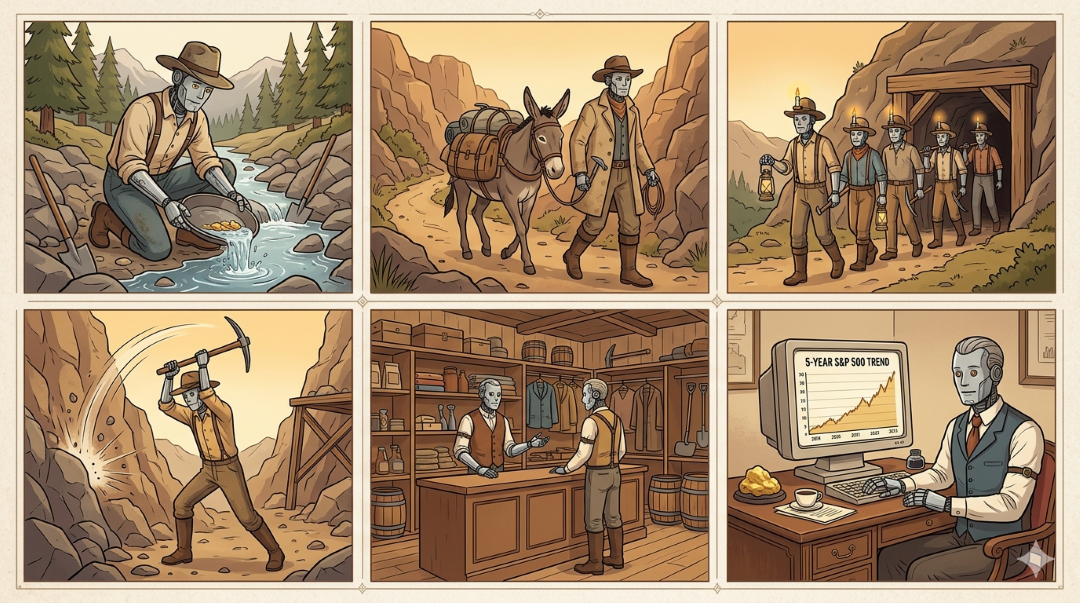
TL;DR: Most people who chased the Gold Rush didn’t know what they were getting into. They saw headlines about fortunes and stories about how easy it was. Many went because their livelihoods were already threatened. Sound familiar?
Let’s be honest about who the average Gold Rush prospector actually was.
Not a rugged adventurer with a prospecting education and a solid savings account. Not someone who had studied geology or mapped the terrain. The typical forty-niner was a farmer whose crops had failed, a tradesman who had lost his shop, or a clerk who had read a breathless newspaper account and decided a long-shot bet beat a certain slow decline.
The California Gold Rush of 1848 and the Klondike rush of 1896 were separated by nearly fifty years and thousands of miles, but they drew from the same well: economic desperation dressed up as opportunity.
The context matters here, because without it the behavior doesn’t make sense.
The years leading up to the California rush included a global recession following the Panic of 1837, crop failures across the Midwest, and a population of young men with limited options. When James Marshall found gold at Sutter’s Mill in January 1848, the news didn’t just spread quickly, it spread selectively. The people who acted first were the ones who needed it most. Same story in 1896, when word of the Klondike strike reached Seattle and San Francisco during a prolonged economic depression that had pushed national unemployment past 20 percent. The ships heading north were not full of people with a plan. They were full of people with a problem.
Not everyone was running from something. Some were adventurers who wanted something different, or already had a good life and wanted something better. And not everyone coming out of a bad situation went in blindly. What almost everyone had in common were expectations that diverged sharply from how things turned out.
The relevant point is not that these people were reckless. It’s that economic pressure meant the average participant arrived undercapitalized, underprepared, and motivated primarily by someone else’s story of overnight success. They were chasing a headline, not a thesis. The results reflected that, in aggregate, almost immediately.
That pattern matters because it is not a 19th-century phenomenon. It is what every hype cycle looks like from the inside.
Each rush also moved in distinct waves. The rules that determined who succeeded in the first wave had almost nothing in common with what it took to win in the second. Most people who got swept up never stopped to ask which wave they were actually in. That question turned out to matter more than almost anything else.
First Wave: Right Place, Right Time, Right Creek
The first wave of California gold hunters had a genuine advantage. Here is what that advantage actually was. Not superior skill. Not better research. Proximity to the news.
Many of the earliest California prospectors were already in the territory: soldiers, settlers, and tradespeople who heard about Marshall’s discovery within weeks and moved fast. The surface deposits in the Sierra Nevada foothills were accessible, concentrated, and required almost no expertise to extract. A pan, a creek, and a willingness to stand in cold water for twelve hours were the main requirements. In that environment, showing up early mattered more than showing up prepared.
The Klondike told a similar first-chapter story. The initial claims along Bonanza and Eldorado Creeks were staked by prospectors already in the Yukon when George Carmack’s group made their discovery in August 1896. They were not the product of a coordinated strategy. They were in the right place when the right thing happened.
First-mover advantage is real. The people who moved fast in that window got a return no amount of later preparation could have replicated. But the window was short, the geography was finite, and it closed before most people had even heard the news.
Second Wave: The Pan Is Not Going to Save You
By 1852, the dynamics of the California Gold Rush had fundamentally changed. The surface deposits were gone. The creek beds that had yielded fortunes with a simple sluice box were picked clean by the first wave. The second wave arrived to find a very different landscape than the one the newspaper stories had described.
The prospectors who succeeded in the Second Wave did so through entirely different means. Hydraulic mining operations used high-pressure water jets to blast entire hillsides and process material through sluices, yielding gold at scale but requiring capital investment and systematic planning. Geologically-informed prospectors who understood quartz reef formations studied where gold veins actually formed and discovered productive sites where random panning had repeatedly failed. Syndicates pooled resources to fund deep shaft mines that reached deposits unreachable by individual surface workers.
Preparation was no longer an advantage. It was the entry requirement.
The Klondike replicated this pattern almost exactly. By the time the mass wave arrived in 1898 after a brutal trek over the Chilkoot Pass, which the Canadian government required each prospector to complete while carrying a year’s worth of supplies, the accessible claims were long staked. The prospectors who completed that crossing and still found nothing with a pan were not unlucky. They were late, and they were underprepared for the wave they had actually entered.
This is also where technology shows up on both sides of the ledger. The Industrial Revolution had already been displacing Eastern tradespeople and artisans for a generation, which goes a long way toward explaining why those gold rushes had the human fuel they did. Factory looms had replaced hand weavers. Steam-powered equipment had displaced skilled craftsmen. The Gold Rush was, in no small part, a downstream consequence of technological disruption seeking an economic escape valve. And then, within the rushes themselves, industrial technology, hydraulic systems, and organized mining operations began displacing the individual prospector. The image of the lone miner with a pan was already obsolete while people were still forming it.
Gold Wasn’t the Only Thing in Them Thar Hills
Some prospectors did strike it rich. The early arrivals at Coloma, the men who staked Bonanza and Eldorado before the word spread, the syndicates that scaled hydraulic operations with enough capital to actually move mountains. These were real winners. Gold was there. People found it. Fortunes were made.
But a parallel economy was running alongside the prospectors, quieter in the moment and, in the long run, more durable.
Sam Brannan did not own a gold claim. He owned a hardware store, and before he told anyone about the gold discovery, he bought up every pick, pan, and shovel in Northern California he could find. Then he walked through San Francisco holding a vial of gold dust, shouting about gold from the American River. He became California’s first millionaire. He did not find a single ounce himself.
Levi Strauss did not mine. He figured out that miners destroyed pants at an extraordinary rate and needed something that could survive the work. He made pants. Generational brand.
Wells Fargo did not mine. They moved money and packages for people who did. They are still here.
The common thread is not that these people were smarter than the prospectors. It is that they studied what the prospectors would certainly need rather than betting on where the gold might be. The uncertain bet was “this particular creek has gold.” The certain bet was “whoever finds the gold will need pants, tools, and a way to move money.” One of those bets required luck. The other required observation.
This path was available in the First Wave and Second Wave equally. It did not depend on timing. It scaled with the rush rather than competing within it. And it generated more durable wealth than almost anyone who was actually in the river.
The Roaring 20’s
Not the flapper and speakeasy era. This is the era of data centers and solopreneurs; dueling model metrics and learning evaluations; digital assistants evolving into personal agents and agentic automation that builds new automation agents. Billion-dollar funding rounds for companies that did not exist three years ago. Job titles that nobody had in 2021, now listed as critical hires. Entire industries trying to figure out if they are the disrupted or the disruptors, and running low on time to decide.
Models released on a Monday that are obsolete by Friday. Consultants who barely knew what a prompt was in 2022, now billing as AI transformation architects. Boardrooms demanding AI strategies before anyone has agreed on what problem they are solving. Vendors with “AI-powered” on the label whether the product has meaningfully changed or not.
The energy is real. The stakes are real. And unlike some previous cycles, so is the underlying technology.
The dot-com boom was real too. It produced Amazon, Google, and the infrastructure of the modern internet alongside thousands of spectacular failures. The AI shift is already demonstrating measurable productivity gains across industries, and the underlying technology is improving faster than most predictions have accounted for. Dismissing it as pure hype is the wrong read, and the people making that call loudest will look exactly like the analysts who declared the internet a fad in 1997.
The problem is not that people are excited about a real thing. The problem is that when real opportunity appears, it activates the same psychological patterns that sent underprepared people over a mountain pass in 1898. The gold rush mentality does not require the gold to be absent. It just requires the promise of gold to be louder than the instructions.
The opportunity is real. The question is whether you are building toward it, or just rushing toward it.
The AI First Wave Already Happened
From roughly 2022 through 2023, companies that moved aggressively into AI-native product development, workflow automation, or customer-facing AI features got real first-mover advantage: lower competition, compounding productivity gains, and a learning curve head start that is genuinely hard to close. Some of this was vision. Some was access. Some was timing. The window was real, and the returns were real.
Most businesses did not catch it. Large organizations move slowly by design, and procurement cycles are not calibrated for technology windows that last 18 months. That is not a criticism. It is a description of how large organizations actually work. (I have been in those rooms. Guilty.)
What it means is that most businesses are now in the Second Wave, whether they have acknowledged that or not.
Second Wave Requires a Different Playbook
The companies treating AI adoption as a First Wave problem in 2025 and 2026 are showing up in California in 1852 with a pan. The accessible value has been captured. What remains requires the methodical approach.
Imagine you could see exactly where your organization loses an hour a day to rework, manual handoffs, and decisions made on bad data. That is what a process audit produces. It is not glamorous. It does not show up in the conference keynote. But it is the difference between knowing where the gold is and hoping the next creek looks promising.
Start there, not with tool selection. Map where time, money, and errors concentrate in your current operations. Identify which problems AI can address with reasonable reliability, and which ones it will make worse by hallucinating confidently inside a business-critical workflow. Run contained pilots with defined success criteria before scaling anything. Build internal AI literacy and governance at the same time you build capability, not after something goes wrong publicly.
Then, only after you understand what AI can reliably do in your specific context, start redesigning processes to take advantage of it rather than bolting it onto what already exists. The order matters. Inverting it is how you end up running hydraulic equipment you do not know how to operate into a hillside you have not assessed.
Preparation is not glamorous. But it is the entry requirement now. That distinction matters.
The Niche Play Nobody Is Talking About
Here is the thing about Sam Brannan, Levi Strauss, and Wells Fargo: none of them would have been described as gold rush companies.
Brannan was a merchant. Strauss was a dry goods trader. Wells Fargo was an express and banking operation. The Gold Rush was the economic context that made their businesses thrive and scale, but their identity was not “gold rush business.” Their success was driven by the rush. They were not of it.
While the gold rush era was a boon to the merchant class, imagine if technology had been more advanced then. Gold is one of the most effective electrical conductors on earth. It does not corrode. It does not tarnish. It carries signal reliably in conditions that defeat most other materials. Today it is in every smartphone, every circuit board, every aerospace connector, and every implantable medical device. The miners panning those California creek beds were sitting on the raw material for the digital age and had no way to know it. They were chasing the obvious use. The compounding value was in applications that had not been invented yet.
AI is playing the same role for business processes right now, visible to anyone paying attention. It is the super conductor of this moment, not for electrons but for decisions, workflows, and the intelligence buried inside operations that were built for a different era. And just as the real gold economy grew around refining, transporting, and applying the metal rather than simply extracting it, the real AI economy is growing around discovering, implementing, and refining how AI connects to the work that organizations actually do.
Every organization trying to adopt AI will need clean, well-governed data. They will need people who can actually work alongside these tools rather than just technically access them. They will need integration between new AI capabilities and legacy systems that were built for a different era. They will need expertise in figuring out which processes actually benefit from AI involvement and which ones just look like they should.
None of that requires building a foundation model. None of it requires a large AI research budget. All of it requires observation, the same skill that made Sam Brannan wealthy while everyone else was panning creeks.
The businesses that build toward serving those needs may never be described as AI companies. They will be managed service providers, training firms, systems integrators, compliance consultants, data governance specialists. The AI boom will be the context that defines their era, even if it is not the label on their door.
That is not the consolation prize. That is the long game, and it has the most reliable odds.
Your Actual To-Do List
Three questions worth answering honestly before the next AI initiative.
Which wave are you actually in? If you are evaluating AI tools for general business adoption in 2025 or 2026, you are in the Second Wave. The First Wave is not waiting. Adjust your expectations and your approach accordingly.
Are you prospecting or supplying? If you are using AI to improve your own operations, you are prospecting. If you are building toward serving the certain needs AI adoption creates in your industry, you are supplying. Both are valid strategies with very different playbooks.
Are you auditing before you automate? The methodical prospectors of the Second Wave studied the geology before they dug. The equivalent is understanding your current processes, your data quality, your organizational readiness, and your actual use cases before purchasing a platform and announcing an AI strategy.
The Gold Rush did not reward the desperate or the hasty at scale. It rewarded the timely, the prepared, and the observant, in that order, depending on which wave you caught.
The AI boom is running the same playbook. The question is not whether the opportunity is real. It is whether you are building toward it the right way.