Download it from https://www.logic2020.com/transition-legacy-systems-to-single-target-platform-ebook.
Published Articles
Most of the posts are just notes, but some are more like articles, or actually were articles that were moved here once my rights reverted back per contract. In other cases they are cross-posted on a vendor blog site.


Be Prepared for Meetings
The concept seems like a no-brainer, and maybe it is just my personal experience, but anytime a poll of the meeting attendees is run asking if they reviewed the material sent prior to the meeting, the overwhelming majority response is “no”.
I was reminded of the importance of being prepared while listening to an episode of one my favorite podcasts, “Think Fast, Talk Smart” (please see my YouTube channel for a link to the podcast playlist and subscribe to my channel while you are there so I can finally get a vanity URL). The episode was titled Communicating Our Mistakes: How to Avoid Common Flaws and Make Better Decisions, which I admit was not one of my favorite episodes, but it did spend some time on this topic of preparation, which triggered a confirmation bias response from me. It started with a learning approach where the teacher asked students to complete the lessons before the lecture so that lecture time was spent building on top of that, then moved on to how meetings are more effective if people review the material in advance and discuss in the meeting…
[sounds of wood scraping across the floor as the author pulls his soap box out]
There are corporate cultures where materials are not provided in advance, probably because of the tendency for people not to review them. This makes the problem worse. These same cultures also frequently have meetings schedule with no agenda. I had someone on one of my teams who refused to attend meetings without an agenda. It was difficult for me to fault him, as I agreed with his reasoning.
People hate meetings because they are often inefficient and inclusive. My approach is to go the opposite direction of those who stop sending the material in advance and including agendas: I avoid reviewing the material in the meeting and instead advise those who didn’t to take notes and review it after the meeting. Depending on the purpose of the meeting, I may just reschedule it and advise everyone to come to the next meeting prepared. This may seem anti-[your pet sentiment here], but my experience has been that people become much more productive when they come prepared as a result of the meeting being more productive and few meetings because things were accomplished the first time.
Finally, if your organization has the ability to record meetings, do so. Notes taken during meetings require that the note taker split their attention, so either something will be missed or they have a great auto-writing process that most do not. And memories are worse than notes, and even worse when prompted by notes that were taken with the expectation that all context would be retained when reviewing (hint: it won’t). Most meeting software that records has an auto-delete time period, so preserve elsewhere if necessary or let it expire if it turns out it isn’t needed. The recording may just save you from another meeting to go over the same agenda (or even non-agenda).
[author returns his soap box to easily-accessible storage location]

Keep Emails to a Single Topic
Many people could write entire books on email tips. I think the best I could do would be a pamphlet, and the single topic “rule” would have one of those click-bait sub-headings like “if you only learn one thing about writing emails, this is it”, at least as far as value and productivity go.
Before proceeding, a general comment (rant) about rules: Rules are not laws. Laws (at least physical ones) are absolutes. Do this, that will happen. Rules (outside of software) are suggestions based on experience that have proven useful. They are not always true, but they are more often than not and are therefore good guidance when no other factors indicate otherwise. And this definition is not the rule of law, only an agreed upon notion to save three more paragraphs of this kind of exposition 🙂
So, I will start off by violating the rule (to a degree) in describing the rule as having more than one part. The first part of the rule is simple, which is that subject of an email should be focused on a single topic, and the body of the email should not stray beyond that. One reason for this is clarity. If the topic changes within the body of the email, readers may become confused. Confused? Really? Yes. The process is not all that different from The Telephone Game, except that the readers’ attention is all of the players, and everytime there is a distraction it is the same as one person telling the next. Sometimes it will come out as it went in, and other times it will vary, and if it happens enough times the original may not resemble the end. This is especially true for people who have to read many emails throughout the day (or all at once, if you are following some YouTube videos on productivity) read them very quickly, and the topic change may lead them to forget the original purpose of the email (like you may have forgot where this sentence was going with these parenthetical comments of mine that are a habit I may change one day).
Changing subjects in an email can become even more problematic in the event that the email becomes a thread, because the subject in the full inbox will not match the topic in the email and may not be prioritized properly. The other problem with content not matching the subject is when trying to locate the email later. Yes, a diligent search will find it, but how often have you been searching for something only to be distracted when it isn’t found right away and never coming back to it?
The second thing about keeping to a single topic is that many people will treat an inbox as a, well, an in-box. Meaning once the subject matter has been concluded, any further emails will be either given a low priority or ignored entirely as “complete”. And, the distraction phenomenon appears again for the people that live under a perpetual email avalanche, this time when there are multiple action items in the email for a single recipient. Often they will complete one item and consider it “done”, leaving the other items forgotten (frequently because an IM, text, or person distracted them before finishing the message). Email senders not aware of this phenomenon will sometimes wait for the rest of the response in vain. Worse, they may take the lack of a complete response as a personal affront rather than a result of too much information and too little time.
If you only remember one thing from this rambling message, it should be to remember to stick to only one thing in your messages for best results.

Salesforce Trailhead “Challenge not yet complete” most common causes
Ah, Spring is in the air. So are arms, as people new to Salesforce throw them up during Trailhead challenges where they can’t seem to get the hands-on part to pass even though they see the result they expect.
The Trailhead modules and Superbadges are so well organized and written, it may seem like there is an instructor reviewing you submissions, but that would not be practical, profitable, or in the spirit of a cloud platform. The scoring is done by automated tests that are checking that things match exactly as the instructions provided.
The most common cause is that the learner has mis-typed a value provided, usually the API name (i.e., my_variable__c). Runner up to this is the experienced user who is new to Trailhead and uses their own naming conventions rather than following the instructions (been there, done that).
The third common cause is that the module content was updated but the test was not (doesn’t happen that often, but you can tell when there are a bunch of questions on the Trailhead Community about the same problem).
Here’s another I often see. Some of the lessons are re-used between modules and trails, or were once in a different order. Regardless of how it got to be, the instructions may say to create a new playground when one has already been created for the module or trail, and work done previously is required to continue.
A couple of similar issues to the above I have also seen is when there are steps described in the lesson content and the challenge assumes these steps were done in the playground. Alternatively, it is sometimes not clear to new Trail Blazers that the same playground should be used throughout a given module or trail, or they inadvertently select to create a new playground or select the wrong playground. Personally, I use a collection of Developer orgs instead of playgrounds to make it easier to go back and find something I had done previously, but I don’t recommend that for most beginners.
This is not an exhaustive list. If you got through it and still haven’t seen Assessment Complete! +500 points, read through the module from the start as if you had never seen it before. Depending on your input processing style, you may want to wait a day or two. Or post a request for help on Trailhead and be sure to include a link to the lesson and module in your request. And feel free to tag @Scott S Nelson.
HTH
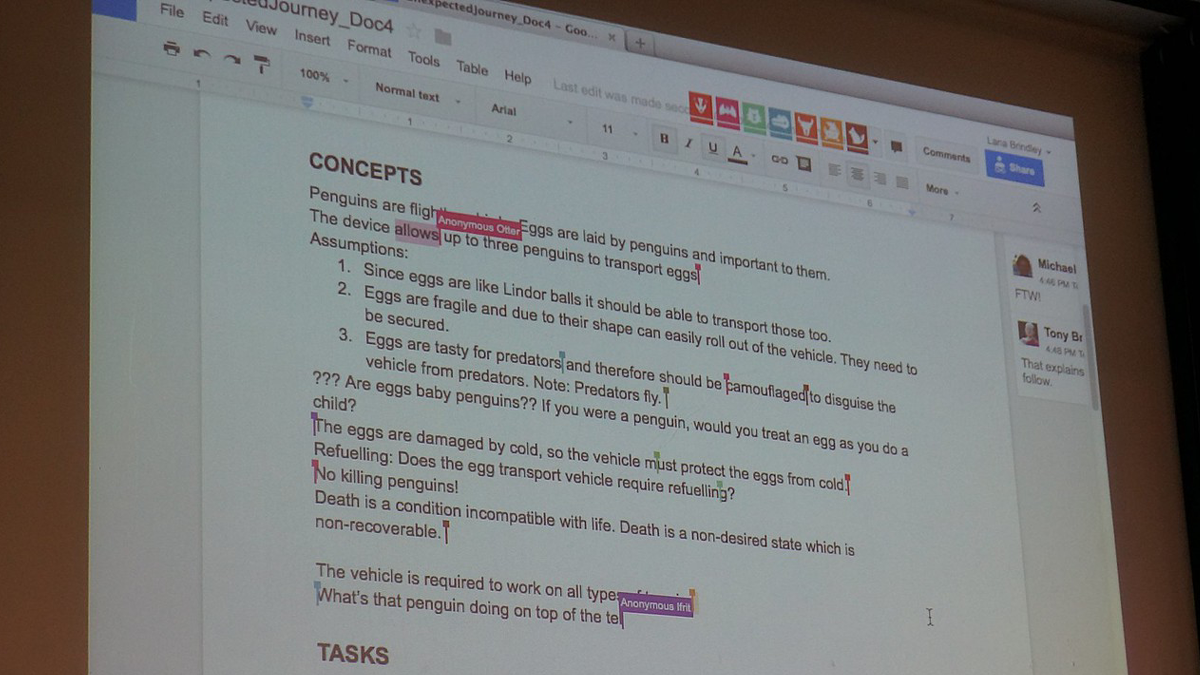
Provide Document Feedback for Efficiency
(Featured image “Collaborative documentation editing” by 4nitsirk is licensed under CC BY-SA 2.0.)
When providing document reviews with comments or track changes, most people start writing their comments as they read through. This is perfectly natural and recommended, as capturing your thoughts immediately is the best way to ensure they aren’t forgotten. That said…
As you read through the document, some of your comments made earlier may be addressed later in the document. If you think the content should be moved, this is a good time to point that out, referring back to your earlier comment. If not, take the time to move the comment to the appropriate point, or revise it accordingly.
Short-term memory varies between person to person and even context to context. A comment provide early in the doc is likely to be remembered and reference back when it discovered at the end that it was not necessary if the review is done in a single sitting or as part of a very focused project. Then again, someone stopping by to say “hi” or an IM popping up immediately after writing a comment can pop the memory out of the short term queue and only invoke vague familiarity if the concept is addressed later. Because of this unplanned and unschedulable variation in memory reliability, I suggest re-reading through all comments prior to submitting them. It will (hopefully) catch those forgotten inputs that should be revised in the context of the entire document so that the sent input is concise.
The value of concise input is two fold: It makes it easier for the person receiving the feedback to apply it where needed, and it avoids the frustration of seeing comments from a review that the author knows are not valid because they are addressed later on.