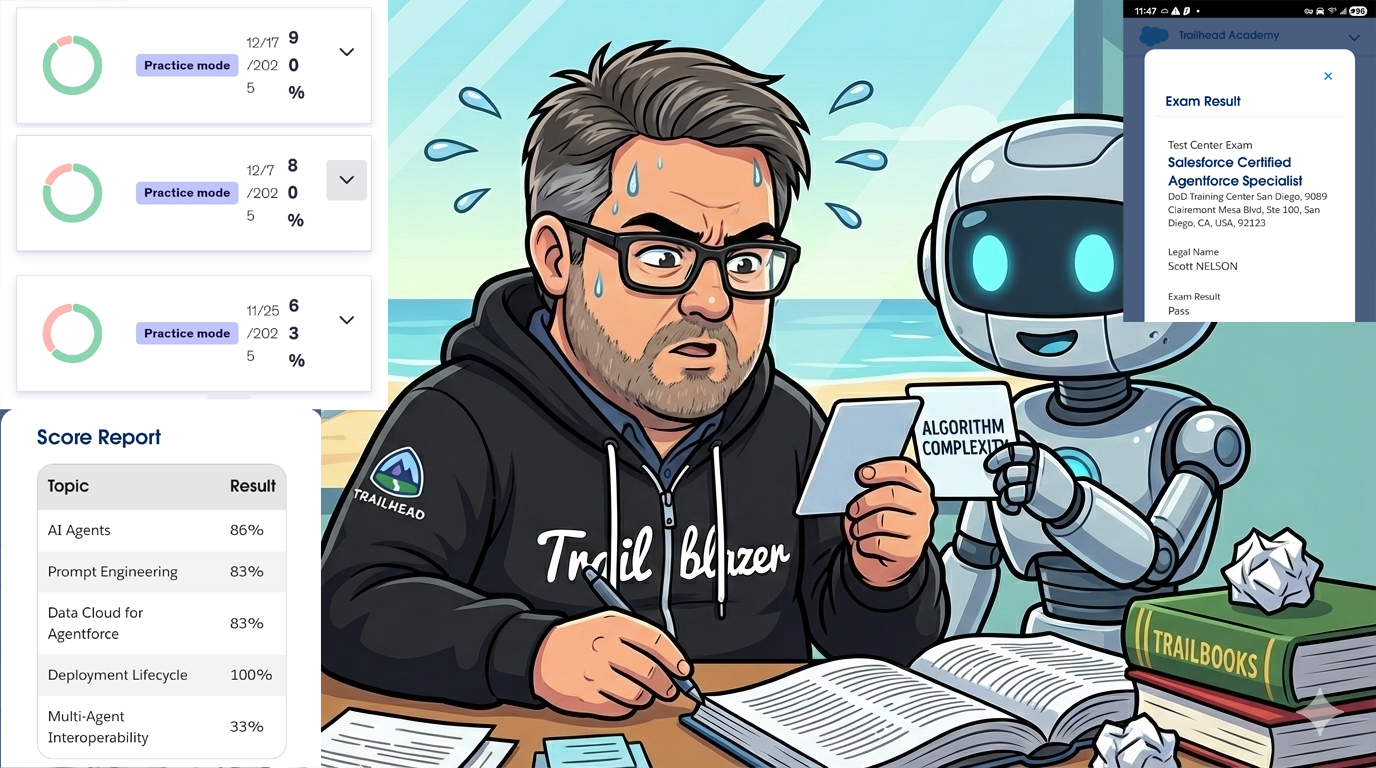
Get Certified as an Agentforce Specialist

Most readers of this post will be too late to take the exam for free . . . which is why I am writing it.

I’ve been following the Salesforce Quests for years now. I first became aware of them when I would receive emails that they were ending with a week or less to finish them when they were always monthly and unique each month. When I had free time, I would jump in and finish them. Sometimes I would receive some merch several weeks later. Then I received a certification voucher when I only had one cert, and I tracked down the URL where the Quests are announced and set a monthly reminder to check for new ones. The Agentforce Specialist is my sixth certification, and I only paid for the first (technically, not even that one, as I talked my employer into allowing me to expense the exam). The rest I won vouchers for, with the exception of this one, which was free to everyone until the end of 2025.

Wall of Swag

I discovered the fact it was free while working through the Agentblazer series of badges. The final badge, Legend, requires certification and that is when I discovered it was free. The certification was free for quite some time, but my employer at the time did not get many Salesforce projects and I had missed the news. I discovered that it was free on October 10, and became determined to pass this one, too.

Even though I don’t get to work in the Salesforce ecosystem as much as I would like to, those monthly reminders to check out the latest Quests keep me involved in keeping up with the changes. So when I started on the Agentblazer series of badges, I already had some trails and modules under my belt, and quickly advanced to the Legend level where I learned of the free certification. Even so, I can honestly say that the Agentblazer Legend quest has been the most difficult I have worked through (disclaimer: at the time of this writing I have not completed the quest, but I will within a day or two . . . check my profile to keep me honest!) in almost a decade of questing.

But, truly, my core skill is digressing, and I have from the topic of getting certified, so back to it . . .
First, definitely earn the Agentblazer badges as a foundation. The path to earning them will prepare you for what comes next.

Which is, as I have always recommended for certification preparation, buy a pack of practice exams with as many quality questions as you can find and work your way through them. For this particular certification exam I used a Udemy course, Salesforce Certified Agentforce Specialist – Practice Exam (currently on sale for $9.99). One of my other blogs is “Cheap, Lazy Investor”, and to the cheap part, I did not buy any other practice exams because this one did the trick. It has 365 questions (not all unique) and they covered 95% of the concepts I found on the actual exam, so no complaints and some kudos.

Passing the exam requires a combination of rote knowledge and conceptual knowledge. Of the two, conceptual knowledge will bring the higher score. You can’t get by with just one. Rote knowledge is necessary for questions where there is clearly only one right answer. Conceptual knowledge is necessary to answer those questions where more than one answer is correct, because one answer is more correct than the other. The “more correct” is driven by understanding what is key to Salesforce and Agentforce. Concepts such as security, flexibility, and that the standard option is the best option if it meets all of the requirements. Use the practice exam to get examples.

Interestingly, while the value of LLMs is their ability to manage probabilistic responses, if one answer leans towards probabilistic and the other leans towards deterministic, the deterministic answer is most likely the correct one. Getting the most likely answer when your own knowledge isn’t helping is where conceptual knowledge is key.

The deployment lifecycle section of the exam focuses on what is specific to Agentforce. I had a really hard time getting NotebookLM to stick to that scope. After two failed attempts where it produced very detailed preparation around the full Salesforce Application Lifecycle Management, I finally created a new notebook, ran deep research specifically on deployment lifecycle processes and pitfalls related to Agentforce, then added my own missed questions and had it generate a note, which I then added as a source and ran the audio prompt again: “Focus only on making the contents of ‘Missed Practice Exam – Deployment Lifecycle.md’ thorough and memorable to the listener to ensure the reader can correctly answer all questions regarding the Agentforce deployment lifecycle questions in the Salesforce Agentforce Specialist certification exam. Avoid the use of emphatic expressions and emphatic modifiers. This is important.”

One important thing about practice exams: They are not the exam you will be taking. The value of reviewing the questions you missed is in identifying the concepts that are not solid in your thinking. This is one of the reasons why it isn’t too bothersome that NotebookLM goes outside the boundaries of provided content when generating the podcast audio. And don’t rely on NotebookLM to catch it all, either. If you miss the same question three times on a practice test, go read the material, re-do the Trailhead module, and create some Bionic notes on the topic. Sound like overkill? There is almost always some questions on the exam on topics not covered by the practice exams, so be fully prepared for those you can expect to answer will offset any score impact of topics that you never heard of until the exam.

I did not use Bionic notes this time. I still think it is a valuable technique.

If you’ve read my other certification articles, you will know that I use notes formatted as Bionic Reading® to review my notes on missed questions and key concepts. And that I sometimes use my own version, where I bold keywords rather than parts of words to get the concepts to stick. I stand behind this approach, but didn’t do much with it this time.

This time I used NotebookLM. I used advanced search to find links to content, plus links from the Trailhead content, and my own study notes exported as markdown from UpNote to create source content. Then I incrementally created generated AI audio content that I posted on YouTube and listened to continuously to drill the concepts into my head.

At the end of the day (or almost the end of the year), I passed the exam.

I also highly recommend the Salesforce Ben page for prep (and the site in general).

Good luck!

If you found this interesting, please share.

© Scott S. Nelson

How to Pass the AWS CLF-C02 Cloud Practitioner Exam the First Time

People say the Cloud Practitioner exam is easy. Easy to say if you have used all of the AWS products as an administrator. For me, it took some work. Here’s how I did it.

Updates?

For the record, this is for the CLF-C02 exam, based on having passed it on September 12, 2025. If you’re reading this in the future, check that the exam details haven’t shifted. The process to prepare and pass will be the same, but the details may vary over time.

Despite the name, Cloud Practitioner isn’t all that magical. Though I think one of the most important aspects of this certification is understanding how to manage your AWS account cost effectively, which some may see as magical.

The Formula

As my seventh article on how I have passed certification exams I have prepared for, I have come to a formula that works for me. I still continue to refine it, and added something new this time (yes, of course it is AI-related).

The current formula is this:

  1. Start with a quality exam prep course.
  2. Find a set of practice exams that has at least 5 times as many questions (total) as the actual exam.
  3. Repeat the practice exams until you consistently score over 90%. (trust me on this one)
  4. (New!) Use NotebookLM to generate a podcast of the material you are weakest on and listen to it repeatedly for a few days before the exam.
  5. Schedule the exam for a time of day when you generally find it easiest to concentrate.

Optional Bio hack

There is one additional ingredient I use, which may not be for everyone. I take focus supplements, sometimes called nootropics, and wash them down with a Starbucks Double Shot. This is the third time I have gone the bio hack route. The first two times, I had missed that step of scheduling at a time of day when I am my sharpest, because work schedules were in the way. Both of those times I felt that I really got a concentration boost. This last time, my schedule was more flexible and I don’t think the combo really helped all that much.

A Scout is Always Prepared

This time around, there was another formula side-step in that I did not find the prep course I took to be of particularly good quality. As such, I’m not going to share it, as I usually do with those I liked. This time around, I was very budget conscious and used a course I had access to for free. It did help by giving me exposure to topics I had not had to deal with as part of my regular work, but I credit my long experience in technology for being able to extract value from the content rather than the quality of the content. There were several topics where I used Perplexity to fill in the blanks that I picked up on during the course.

Practice Makes…More Likely to Pass

The practice exams, however were great. I used AWS Certified Cloud Practitioner Practice Exams CLF-C02 at Udemy. It had 6 full sets of exam questions. Each set felt tougher, possibly because newer questions crept in. My scores reflected that. I think this is better than most practice exams where each set has the topics evenly distributed. Of course, it could’ve just been coincidence that my weaknesses aligned with the sequence.

Another thing I really appreciated in the practice exams is that they didn’t stop at just the correct answers for the test review, it also provided detailed explanations. Other practice sets I have used sometimes only gave a link to the vendor documentation. While the links are more in line with how the vendors would like you to study, I have yet to take one of these exams as a way to learn the material, and the ones where I already (thought) I knew the material, this level of preparation wasn’t necessary.

Practice Level 1

Another feature of these practice exams I really liked was labeled as a “beta option,” though I seem to recall this has been available on Udemy long enough to not be considered “beta.” That feature is to get the answer after each question, rather than only at the end of the exam. I did this for the first pass through of the practice exams.

Almost for Real

The second pass I did it “exam style,” getting the answers after the total score. There were improvements, but no enough. This time, I copied the questions and correct answers into a text file, then converted them to Bionic Reading® notes (if you aren’t familiar with Bionic Reading® notes, they make reviewing notes much easier, and I have included mine at the end for reference) and imported the resulting markdown into UpNote for studying.

One More Time with Feeling

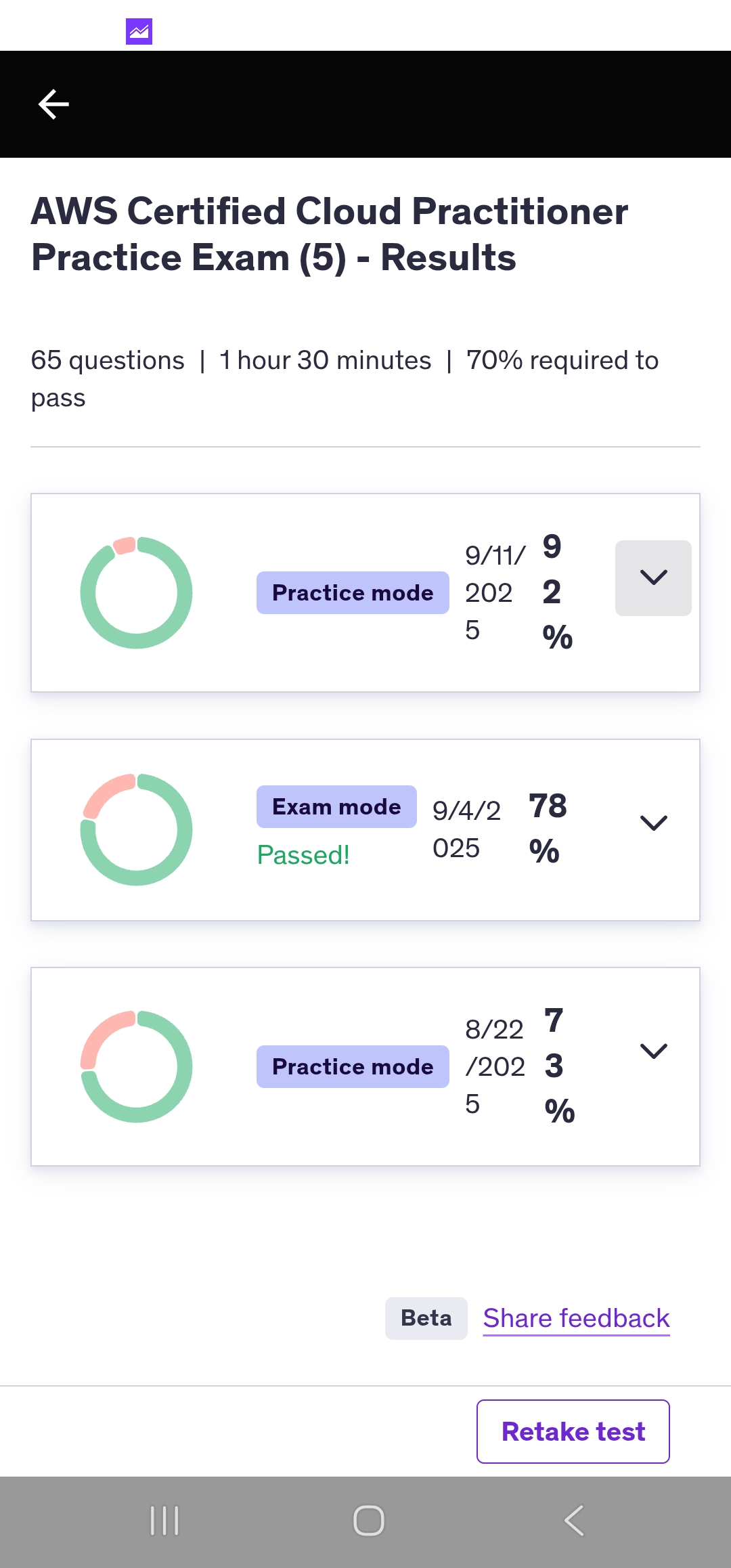
After the third pass, I was almost satisfied with my scores:

Progression in Practice Exam Results

But, my experience with certification exams is that there are always questions in the actual exam that were not covered in my preparation. For this reason, I really prefer to have the practice exams at 100% (which I fell short of this time).

Not Not Necessary (this time)

The practice exams had a few “not” questions which I generally got wrong the first pass and still missed some the second time around. I recently watched an Otherwords video about Why A.I. Struggles with Negative Words, and I still don’t feel better about missing those questions. However, maybe I’m not alone, because there were no such questions in the actual exam I took.

New addition to my standard approach NotebookLM podcast

To help improve my memory of the ones I had missed I went back to the questions I got wrong on the second pass through and noted the reference links to AWS documentation. I then fed those links to NotebookLM and had it generate a podcast, selecting the longest format and prompting that it should target an audience preparing to take the CLF-C02 certification exam. The results were incredibly good. But don’t take my word for it, I have posted the podcast here: AWC CFL C02 Exam Prep Podcast.

Recommended Reading

While I did not use it extensively, I found AWS Certified Cloud Practitioner Study Guide With 500 Practice Test Questions: Foundational (CLF-C02) Exam (Sybex Study Guide) to be a very good resource. I think if I had not been in a rush to get this cert out of the way, I would have started with this and had a better score for it.

If you are studying for this certification, or have already taken it, please share your experience, thoughts, and suggestions in the comments.

My Bionics

Here are the bionic notes I used. Your weak spots may vary, so consider creating your own at https://10015.io/tools/bionic-reading-converter.


Q: What is the benefit of Amazon EBS volumes being automatically replicated within the same availability zone?

A: Durability

Q: Which AWS service can be used to route end users to the nearest AWS Region to reduce latency?

A: Amazon Route 53

Q: What is the main benefit of attaching security groups to an Amazon RDS instance?

A: Controls what IP address ranges can connect to your database instance

Q: What is the recommended storage option when hosting an **often-**changing database on an Amazon EC2 instance?

A: Amazon EBS

Q: What kind of reports does AWS Cost Explorer provide by default?

A: Utilization

Q: What does the term ?Economies of scale? mean?

A: It means that AWS will continuously lower costs as it grows

Q: Which AWS team assists customers in achieving their desired business outcomes?

A: AWS Professional Services

Q: Which of the below options is true of Amazon Cloud Directory?

A: Amazon Cloud Directory allows the organization of hierarchies of data across multiple dimensions

Q: An organization has a legacy application designed using monolithic-based architecture. Which AWS Service can be used to decouple the components of the application?

A: SQS (SNS, and EventBridge)

Q: A company is planning to use Amazon S3 and Amazon CloudFront to distribute its video courses globally. What tool can the company use to estimate the costs of these services?

A: AWS Pricing Calculator

Q: What is the connectivity option that uses Internet Protocol Security (IPSec) to establish encrypted connectivity between an on-premises network and the AWS Cloud?

A: AWS **Site-**to-Site VPN

Q: Both AWS and traditional IT distributors provide a wide range of virtual servers to meet their customers? requirements. What is the name of these virtual servers in AWS?

A: Amazon EC2 Instances

Q: A company uses multiple business cloud applications and wants to simplify its employees? access to these applications. Which AWS service uses SAML **2.**0 to enable single sign-on to multiple applications through a central user portal?

A: AWS IAM Identity Center

Q: A small retail business with multiple physical locations is planning to transfer sensor data and store security camera footage in the cloud for further analysis. The total amount of data is around 8 terabytes, and the business’s internet connection is too slow to transfer such a large amount directly to AWS in a reasonable time. Which AWS service would be the most cost-effective to transfer the data to AWS?

A: AWS Snowcone

Q: Which AWS Service is used to manage user permissions?

A: AWS IAM

Q: A company has hundreds of VPCs in multiple AWS Regions worldwide. What service does AWS offer to simplify the connection management among the VPCs?

A: AWS Transit Gateway

Q: Which statement best describes the operational excellence pillar of the AWS Well-Architected Framework?

A: The ability to monitor systems and improve supporting processes and procedures

Q: A company is migrating its on-premises database to Amazon RDS. What should the company do to ensure Amazon RDS costs are kept to a minimum?

A: Right-size before and after migration

Q: A company is planning to host an educational website on AWS. Their video courses will be streamed all around the world. Which of the following AWS services will help achieve high transfer speeds?

A: Amazon CloudFront

Q: What does AWS Health provide? (Choose TWO)

A: 1) Detailed troubleshooting guidance to address AWSD events impacting your resources

2) Personalized view of AWS service health

Q: Which of the following services allows customers to manage their agreements with AWS?

A: AWS Artifact

Q: You have set up consolidated billing for several AWS accounts. One of the accounts has purchased a number of reserved instances for 3 years. Which of the following is true regarding this scenario?

A: All accounts can receive the hourly cost benefit of the Reserved Instances

Q: A company is deploying a new **two-**tier web application in AWS. Where should the most frequently accessed data be stored so that the application?s response time is optimal?

A: Amazon ElastiCache

Q: If you want to register a new domain name, which AWS service should you use?

A: Route 53

Q: If you want to visualize your spending on your AWS account for the past month, which tool can help you?

A: AWS Cost Explorer

Q: If you go for consolidated billing for multiple AWS accounts under three master accounts, what benefit do you get?

A: Combined usage for discounts

Q: For which support plan do you also have AWS support Concierge Service?

A: Enterprise

Q: Which storage option should you use if you are hosting a frequently-changing database on an Amazon EC2 instance?

A: EBS

Q: To get a high throughput to multiple compute nodes, which storage service would you use to host an application on your EC2 instance?

A: EFS

Q: If you want to upload data to S3 at very high speeds, which AWS service takes advantage of the edge locations?

A: S3 Transfer Acceleration

Q: Which one of these can you NOT assign to a user?

A: IAM identity. You cannot directly assign an “IAM identity” to a user because “IAM identity” is a generalized term referring to any entity in IAM (such as users, groups, or roles).

Q: You have been asked to contact AWS support using the chat feature to seek guidance on an ongoing issue. However, when you log in to the AWS support page, you do not see the chat options. What should you do?

A: Live chat support is only available with Business, or Enterprise Support plans

Q: If you want to launch and manage a virtual private server in AWS, which service is the easiest?

A: Lightsail. Lightsail provides pre-configured virtual server instances

Q: What is AWS Athena?

A: AWS Athena is a serverless, interactive query service that enables you to analyze data directly in Amazon S3 using standard SQL

Q: Choose from the options below to filter your incoming traffic request to your EC2 instance.

A: NACLs and Security Groups

Q: Protect from dDOS attacks?

A: NACLs and Security Groups

Q: Where can you find your historical billing information in the AWS console?

A: Billing and Cost Management console

If you found this interesting, please share.

© Scott S. Nelson
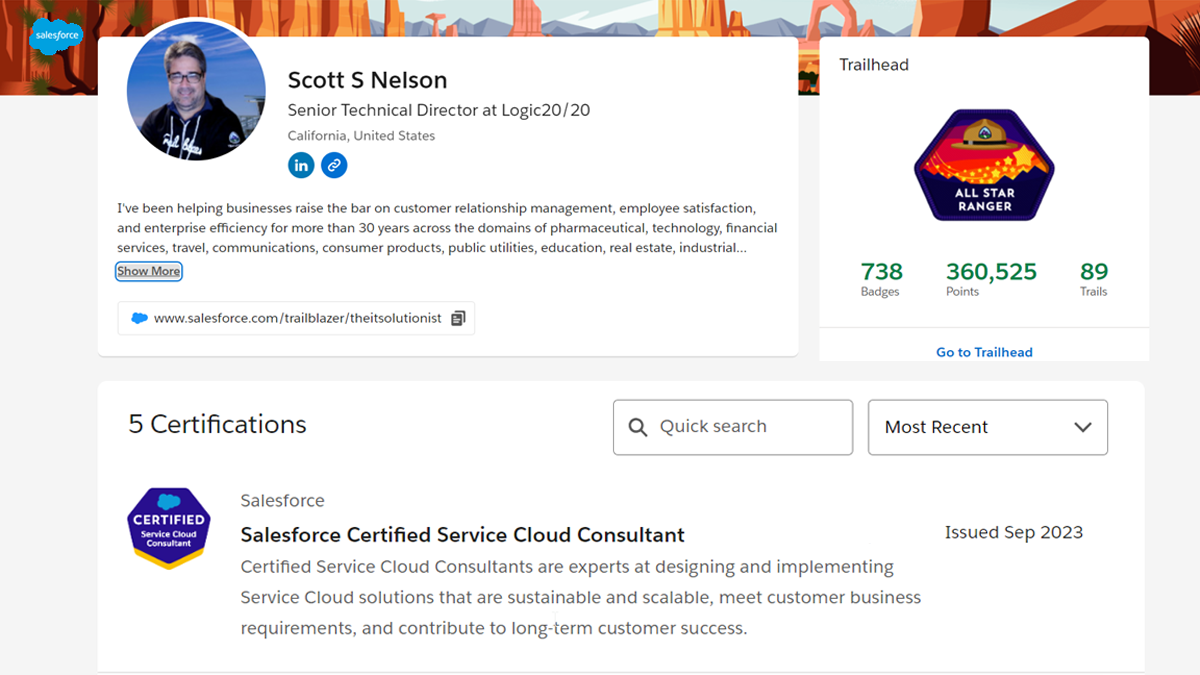
Scott S Nelson Certified Service Cloud Consultant

Passing the Salesforce Service Cloud Consultant Certification Exam

I’ve written about the process I have gone through for all of my Salesforce certifications.  The Certification Prep section of my blog currently starts with these, and I believe that many of those posts also have some helpful tips for the Service Cloud Consultant Certification. If you haven’t already passed the Administrator certification, I would suggest starting with my Tips to Pass the Salesforce.com Administrator Certification Exam post. Enough self-promotion, on with the sharing!

As mentioned earlier, this isn’t my first post on certification approaches and if you are preparing for Service Cloud Consultant certification it isn’t your first exam, so I’m going to minimize the elocution here and just drop my formatted notes by section headings for easier reference.

Start with Trailhead

The proscribed place to prep, completing the Service Cloud Specialist Superbadge will have you well prepared for a passing grade if you work all of the prerequisites and then the Superbadge itself. I did complete the prerequisites but have not yet done the Superbadge project. This is much more a comment on my other time commitments than the approach as I highly recommend completing the Superbadge project, preferably right before taking the exam.

If you also have a reason to not be able to fit the Superbadge into your preparation plan, I recommend completing the Get Started with Service Cloud for Lightning Experience trail. Some of the trail modules are part of the Superbadge prerequisites, so it will take less time than you might think.

Quizlet

Quizlet is a great free resource for some exams, and the Service Cloud Consultant is one of them. https://quizlet.com/272794451/salesforce-service-cloud-consultant-flash-cards/

Udemy

I’ve used Udemy to prepare for every Salesforce certification, and have already enrolled in the Salesforce Data Architect Course for my next planned exam because it was on sale. For those who haven’t used Udemy before, they have frequent sales where the prices are drastically below their regular price. By signing up for their marketing notifications you will eventually get a feel for how low particular courses can drop to, so if you have some planned, buying on sale is a great strategy.

Returning from that digression (my regular reader is used to this), I enrolled in the Salesforce Service Cloud Consultant Certification Course by Mike Wheeler because I had previously taken his Platform App Builder course (as mentioned in Become a Salesforce Certified Platform App Builder) and found it helpful in preparation. I will admit I was disappointed with the Service Cloud course. It was recorded in 2018, and while the Udemy listing says it was last updated 11/22, I couldn’t see where. He continually points out Lightning issues that have long since been addressed and spends a lot of time in Salesforce Classic, which is no longer referenced in the exam. And, while the functionality of Live Agent changed very little when being re-branded to Salesforce Chat, there are a couple of questions in the exam where the Live Agent option is the wrong answer.

And, for the record, I do not get a commission if you enroll in a Udemy course I recommend…and not for lack of trying. Their affiliate program has too much friction to bother dealing with (and it is reflected in my losses as a shareholder).

Focus on Force

I won two vouchers this year (so far, fingers crossed) with Trailhead Quests. The first voucher was for a $200 exam and the second was for a $400 exam. My certification path is focused on Technical Architect and I had done all of the $200 exams, so I sat on that voucher for awhile. When I won the $400 voucher I was a bit surprised to find that it had a shorter expiration period. I immediately scheduled my exam for the expiration date and plowed into My Sharing and Visibility Architect Path.

I rested my brain for a couple of days and decided to use the first $200 voucher on the Service Cloud Consultant certification (sometimes called just Service Cloud Certification). For the Sharing and Visibility Architect exam I tried a few Udemy practice exams because they have served me well for previous exams. I requested refunds for all but one, and that is because I had been to busy to start on the first one and the guarantee period had expired. They were awful. I then went to the Trailhead Community and asked folks there for a recommendation and discovered Focus on Force.  I will keep looking for study courses on Udemy, but for Salesforce practice exams, Focus on Force will be my go-to from now one.

My process was to first go through all of the Topic Exams and then start on the Question Bank.  Then I had some issues with Question Bank on mobile, so I did practice exams on mobile and Question Bank on PC. Once completing the first 20 Question Bank exam, I found I needed to focus in these exam areas:

  • Contact Center Analytics
  • Interaction Channels
  • Knowledge Management
  • Solution Design

This is one of the reasons I don’t consider certifications a true test of consulting skill. I have delivered well-received proposals and solutions using Knowledge Management, and am regularly approached for my solution design expertise. The exam questions cover some narrow areas of very broad topics, and the questions I missed are are about activities that are generally one-and-done… then forgotten and looked up again when next needed. But, certification is important in the Salesforce landscape, so I spent time drilling on things that I would still have to look up again in a couple of years.

I went through the Udemy course in parallel, partly because I only had 55 days to prepare and a demanding day job, and partly to see if this approach was better than first doing the course and then using the practice exams.

Where previously I found the feature to check questions individually instead of at the end of the exam useful, this time I found that I did better if I waited until the end. I think this has a lot to do with my not knowing as many answers as the start as I had for the Sharing and Visibility exam (which I found surprising in itself) and that my expectations changed as I saw immediately that I was wrong. Unless you have an eidetic memory your frame of mind can impact your score more than the knowledge you have accumulated.

The Focus Review feature has the same issue as the Question Bank when used in Chrome on Android mobile devices. The score calculation at the end fails to complete. It then remembers the answer state the next time either is tried. Because both use random questions, some will have the answers from the previous session. I reported this twice for Question Bank and once for Focus Review and no fix has happened yet. If you run into the issue, please report it and then stick to using a PC for those test types. The answers from the failed mobile session will still be there the first time but subsequent attempts will work properly so long as you don’t try mobile again like I did (sometimes I’m optimistic when I shouldn’t be).

Bionic Reading® Notes

I use https://10015.io/tools/bionic-reading-converter to format my notes for Bionic Reading®. Below are the ones I made to review just before the exam. They are specific to reminders I thought would be useful as I created the notes and I recommend you create your own, or supplement these with your own.

For the Industry Knowledge questions, when not sure always go with the one with the highest cost savings followed by the one with the most potential income result. Again, this is only when unsure. There are some questions where cost is not the key factor of the question, for example when considering the benefits of an email channel, lower cost may not be the correct answer as there are other options that are a lower cost than email.

For processes, Case Stages are driven by the Case Status field

CTI allows telephony services in Salesforce. No desktop software or softphone required.

Customer SLA = Entitlement

List views are automatically created for queues

Customer Service site template for Questions to Case, not Customer Portal

Console History component shows recent primary and sub tabs. Recent items shows records

Email to case has a limit of 2500 per day

Knowledge does not return solutions only articles that are related to similar cases or questions

Messaging is what was called Live Messaging and not related to Social

Enable Case Comment Notification to Contacts is a support setting

There is no case field alert

Email approvals require Draft emails

Service Console requires Service Cloud User license

Knowledge Publication Teams and Publication States do not exist

In the routing model, you choose whether to push work to agents who are Least Active or Most Available. If you select Least Active, then Omni-Channel routes incoming work items to the agent with the least amount of open work. If you select Most Available, then Omni-Channel routes incoming work items to the agent with the greatest difference between work item capacity and open work items.

Internal metrics focus on what happens inside the contact center, and external metrics focus on what happens outside the contact center.

Case Sharing Rules by Record Owner:
Public Groups
Roles
Roles and Subordinates

If you found this interesting, please share.

© Scott S. Nelson
Salesforce Sharing and Visibility on path to Technical Architect

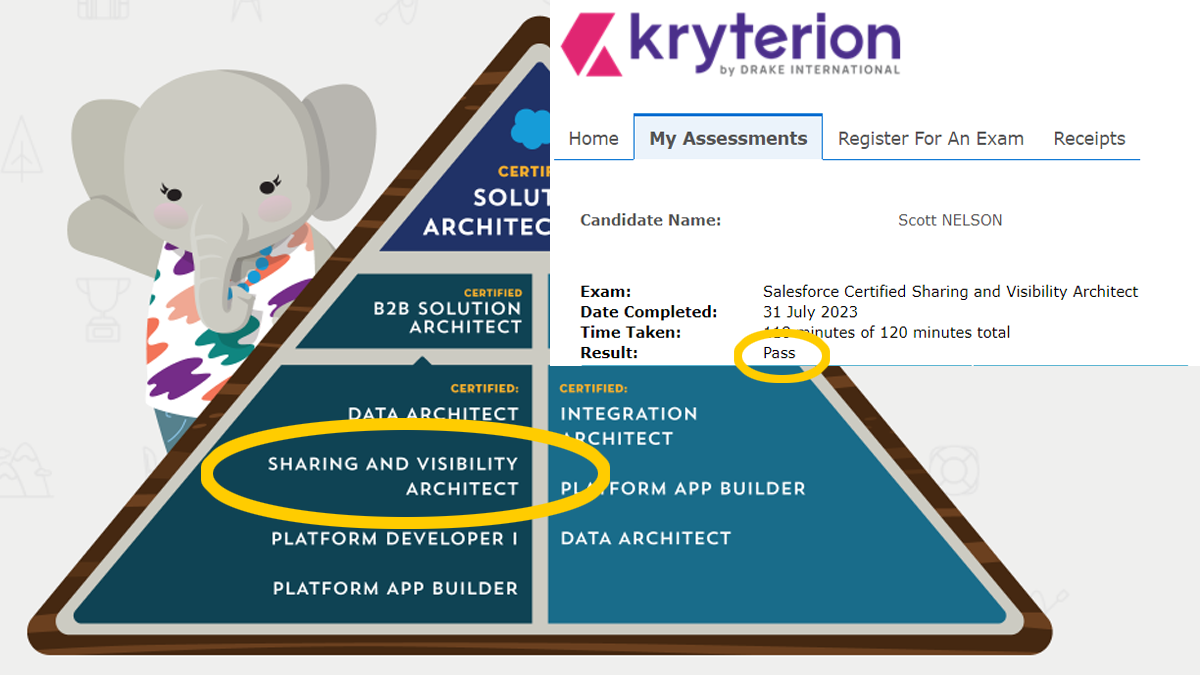
My Sharing and Visibility Architect Path

Full disclosure: This is a quick draft from notes made during my prep journey and quickly edited after passing. Based on comments received, I may revise and elaborate further (hint, hint)

Overview of the Sharing and Visibility Architect certification

After completing the Administrator and Developer certifications, the App Builder certification seemed easy, and I had an expectation they would continue to get easier. I was right and wrong.

I struggled a bit with this certification, for a variety of reasons. First, the earlier certifications are very popular as the best of the entry-level exams. Popularity in this century leads to quantity, and there was lots of high-quality study material available for free and at a reasonable cost. I used to find the Salesforce sharing and visibility topics a bit confusing. They are highly flexible, and flexibility can lead to complexity. The thing about complexity is that when it is well-managed it has a simple core. Getting to that core is the challenge with understanding the subject areas of sharing and visibility and preparing for the certification exam.

Study Guides

For most of my earlier certifications I started with digging deep into the material and the using practice exams to help identify my weaknesses. There are not a lot of courses for sharing and visibility, and many that are out there are out of date. I think part of this has to do with the diminishing number of test takers for this one, coupled with the complexity of the material. Higher effort to address a smaller market reduces those interested in completing. I did find a decent subject matter course on Udemy, my usual go-to for learning anything quick at reasonable price (so long as I can wait for one of the frequent sales). I also found a good, exam-focused series on YouTube that I highly recommend for those like me who want multiple sources and frequently treat YouTube videos as pod casts, using audio-only.

Of course, I also did all of the related modules and trails on Trailhead. There were fewer of these for sharing and visibility compared to my previous certification, too. I also found them less effective in making the content stick in my head.

Practice Exams

Where I struggled was finding practice exams. Most of the ones on Udemy for sharing and visibility are garbage (sorry, Udemy…and I’m a stock-holder, too). One is not too bad, though I think I give it some leniency because of the comparison to what else is available. I finally got frustrated and posted on Trailhead (where I am guilty of answering more questions than I ask, a poor learning strategy). The community did not let me down and came back with a solid recommendation for focusonforce. Their format is a bit different, in that they have practice exams, and they also have section-focused exams. I missed the section-focused being separate from the practice exams until the last minute. I would have felt much more prepared had I found them earlier. They also have a nice feature of 20 random questions that are mixed in proportion to the exam topic mix, which was great for when you don’t have a lot of time and still want to practice.

Oh, yeah, another cool feature from focusonforce is the ability to see the answer after each question instead of at the end. I know there are some free site on other topics that do this, but this is the first time I have seen it with a high-volume and high-quality set of practice exams. It made it easier to make notes on my weaker areas. With better notes, I then used Bionic Reading® forming to make it easier to read them over and over again.

No matter what exam you are preparing for or where you get the practice exams, I recommend taking the practice exams using multiple paces; fast, slow, checking each, checking at the end.

One of the reasons I was so dissatisfied with the Udemy practice exams is that the questions are so long and complex, yet it is still 60 questions each. Well, turns out most of the questions really are long and complex. Still, the Udemy ones missed the actual style of the real questions. Understandable, given the level of complexity, but still disappointing.

Take the practice exams using multiple paces; fast, slow, checking each, checking at the end. When doing the real thing, follow standard practice of speed through and mark for review, etc.. The value of practice exams is more than learning the answers to likely questions. The highest value is in adopting the mindset and thought processes in the context of how exam questions are stated and rated, which is more complex and more constrictive than a typical design session where one can review the problem repeatedly over time and adjust

Tips to taking the exam

  • When doing the real thing, follow the standard practice of speeding through answering the easy questions and marking any with any level of doubt for review.
  • Review first pass unchecking those you are totally confident you are right or totally confident you have no clue.
  • Third pass, commit to an answer.
  • If time remains, go through everything again.
  • On the second pass, read the questions thoroughly. It is the small details in the exam that are easy to trip over.
  • Remember that it’s the best solution given the parameters.
    • If multiple options will solve it, which has an advantage over the others?
    • Which addresses all of the variables in the question?
  • When there are multiple answers that could be right, think about which answer is declarative vs programmatic and which is the most secure

Resource links

Below is a list of resources I used. I hope they help you in your own pursuit.

Trailhead Trailmixes

Udemy

The course I took was Salesforce Certified Sharing and Visibility Architect Course by  Walid El Horr

The practice exam that was OK on Udemy is Salesforce Sharing and Visibility Practise Tests – 100% PASS (that is the title, not an endorsement by me).

Focus on Force

Salesforce Sharing and Visibility Architect Practice Quiz and Sample Questions

YouTube

Sharing and Visibility – Salesforce Certification by CertCafe

Identity and Access Management in Salesforce by Salesforce Apex Hours

Combined playlist on my channel

My notes in Bionic Reading® Format

Generated with https://10015.io/tools/bionic-reading-converter

runAs() is only for test classes
runAs() does not enforce user and system permissions
runAs() does not enforce FLS

Tagging rules have only three options:
1. Restrict users to pre-defined tags
2. Allow any tag
3. Suggest tags

There is no View Content permission

The Salesforce CRM Content User is a Feature License enabled at the User Level (not Profile)

Granular locking is default

Granular locking processes multiple operations simultaneously

Parallel recalculation runs asynchronously and in parallel thus speeding up the process. Creating sharing rules or updating OWD must wait until the recalculation is complete

Initialize test data and variables before the startTest method in a test class

There is NO Account Team Access

Team Member Access is how to view access.

While the permission is Edit, the Apex method is isUpdateble()

While the FLS column is View, the API method is isAccessible()

If want to see group access, look in group maintenance table, not sharing setting for object.

User above a role in the hierarchy can edit opportunity teams of users in subordinate roles

File types cannot be restricted by the library

Opportunities have a Transfer Record permission

Experience Cloud uses Sharing Sets

Sharing rules cannot set base object access

PK chunking to split bulk api queries for large data sets

Rapid access usually means a custom list view

A library with more than 5k files cannot have a folder added

Sharing set in Experience Cloud allows access only to account and contact records.

Share groups are only for HVP users

Schema.Describe.SObject/Field result for permissions

Session based permission set group is more efficient than multiple session based permission sets

There is no Partner Community Plus

Sharing sets can be assigned to profiles

Criteria based sharing rules are only for field value criterion. If no field value criteria, use ownership based sharing rules

Max file size for UI upload is 2GB

EPIM = Enhanced Personal Information Management

Delegated external administrators can’t see custom fields on user detail records

Sharing Hierarchy button is a thing that shows the hierarchy

Share Groups are not available for Partner Community Users

If the default OWD access is changed for an object, it is no longer controlled by parent

There is no Permission Object

Sharing Rules share to groups and profiles, not individuals

Enhance Transaction Security Policy can be triggered by request time length

If only one custom record type is assigned to a user that is the default type for that user.

Territories can belong to public groups

Activities are child objects of any of the following parents: Account, Opportunity, Case, Campaign, Asset and custom objects with Allow Activities.

the ‘with sharing’ and ‘without sharing’ keywords can be declared at the class level, but not at the method level.

The Group Maintenance tables store Inherited and Implicit grants, i.e., the extrapolated grants, which makes sense as extrapolation is more compute-intense than a query.

Partner Community can use Sharing Rules

External OWD must be equal or more restrictive than the Internal OWD

If you found this interesting, please share.

© Scott S. Nelson
Salesforce Certified Platform Developer I

Become a Salesforce Certified Platform App Builder

This is about my journey to pass the Platform App Builder certification exam. Yours will probably vary, and I hope this article is part of it.

For me, Platform App Builder is my third Salesforce certification. I passed the Administrator exam in 2018 and the Platform Developer I certification in 2019. 2020 I was too focused on expanding the Logic20/20 Salesforce Capabilities to study for an exam.

I have admitted in the past, and will repeat for clarity here, that much of my blogging is driven by having searchable notes on how I accomplished something so that when I need to do it again I can readily remind myself of what worked. My certification posts show a pattern that is working: Work with the tool, takes a course, take a diverse set of practice exams, then do it for real. Patterns are great for planning, though the devil is in the details, and I will get to those in just a moment.

Before getting to the good stuff, it is important to note that there is a key part of the pattern that is missing from those previous post, perhaps the most critical aspect: a genuine interest working with the tool that I want to be certified in. The value of this is clear from my first certification for the WebLogic Portal (RiP). I didn’t study for it at all, I just took the exam and passed (barely). I took the exam because it was required by the company that acquired the product. I had passionately worked with it for several years, and expected passing would be easy. It wasn’t, because certification exams are more about knowing things than doing things. Doing them does help to know them, just not as much as I would have thought. Anyway, it is that interest in doing that motivates me to acquire the knowing necessary for certification.

As a mentor, I frequently hear the same concern from people that are learning something new outside of their day-to-day work: It can be difficult remembering things by only reading or hearing about them. Learning exercises are often not enough as they are structured for success and the simple step-by-step instructions become a validation in following instructions rather than an acquisition of the knowledge necessary to perform the task. One thing I had done to rapidly accelerate my abilities in WebLogic Portal was to spend an hour each morning reading the community posts and answering questions. Not only questions I already knew the answer to, but also the ones I did not, by figuring it out, validating it, and then responding. Years later, I applied this technique again after becoming an Informatica Cloud Master. As many people know, solving real-world problems helps to lock in the learning. What I learned with WebLogic and Informatica is that there a plenty of real-world problems to solve beyond my own daily work.

In the case of Salesforce certifications, I can honestly say the best study technique was getting in to the Top 10 on the Trailhead Community Answers Leaderboard.

Beyond the community participation, the App Builder certification was the first one where I did not have frequent “ah ha!” moments while taking the trainings. The first (and last…I repeated it a day before the exam) training I took was the free one Salesforce offers on their Certification Days page. It is certainly worth taking for the pattern tips of how the exam questions are structured, such as (paraphrasing) “If there is a choice that suggests anything other than a declarative approach, it isn’t that one” and “Watch out for choices with multiple parts where most are correct. They must all be correct.”

I’m still a big fan of Udemy. I am also frugal, so I enrolled in Mike Wheeler’s Salesforce Platform App Builder Certification Course during one of the frequent sales. It’s a good course, though a lot of material is dated and it gets a little annoying to hear him complain about features that have long since been improved. The course does not include a practice exam, but I have found that courses that do have few more than the number of questions on the actual exam. The problem with that, is that there are way more questions available, and each exam consists of a random set of questions (within the ratios as described in the official study guide).

The App Builder Certification is one of the more popular ones. I think this is partly attributed to it being in the “Developer” category of certifications while requiring no knowledge of coding, and partly because Salesforce heavily emphasizes that coding isn’t necessary and should be avoided. Having been a consultant for a software vendor, I understand the value of declarative solutions because it is safer for regular vendor updates. I will also say that knowing nothing about the implications of technical choices can be a huge disadvantage even if everything is done declaratively. But I digress…

The practice exam package I went with from Udemy was Salesforce App Builder Practice Test [325 Questions] WINTER’22. There is great diversity in the questions, though there are several that are the same general question with subtle differences. They are spread through 5 timed tests. I didn’t do the actual math, but I think that while the total of all questions are in the correct exam ratio (23% Fundamentals, 17% UI, 22% Data Modeling, 28% Logic & Automation and 10% Deployment), I believe only 2 of the sets are correctly spread across topics. For me, reporting is a weak other (I generally delegate that work), and I found myself failing some of the practices where reporting questions were too heavily waited.

The value of practice exams is not memorizing the answers (don’t, because they change to avoid just that). The value is in learning weak points and shoring them up with some reading or Traihead modules.

As I mentioned, the App Builder is a popular certification, and there are a lot of other offerings on Udemy for practice exams. I made the mistake of buying one several months before using it and could not get a refund. I did get a refund on another that looked really good in the description but was outdated and contained several answers I knew were wrong. There are also several free video dumps on YouTube, and I found that many were also inaccurate, besides being the wrong medium for this type of studying (at least for me).

So, to summarize:

  • Get interested in what you are studying for
  • Attend one of the free Salesforce prep trainings (you also get a discount on your exam with the training!)
  • If you don’t get to build apps often at work, go help people on Trailhead to gain practical experience
  • Pick a good training course on Udemy when it is on sale and check it right away for quality and get a refund if it sucks
  • Pick practice exam set on Udemy with lots of questions and check it right away for quality and get a refund if it sucks
  • Follow me on Trailhead (not really necessary, but you may find some interesting answers)
If you found this interesting, please share.

© Scott S. Nelson