Cleaner Code with the PMD Eclipse Plug-in

Re-post from the original publication on December 4, 2008 at Developer.com.

Most developers like to write clean code. So why is so much code in the world messy? While there are many opinions about this, there are two contributing causes that very most everyone will agree on.

One of the reasons is that there is rarely enough time to write code as cleanly as we would like. Even when code starts clean, the continual refactoring from changing requirements, shifting dependencies and the inevitable bug fixes (often a result of the first two factors) leads to messy code just as surely as short deadlines and long hours make an organized person’s desk become littered with piles of unfiled papers and unfinished notes.

The other reason that is generally agreed on for code in the real world not being as clean as it starts out in our minds is because not everyone generally agrees with what clean code should look like. Some people are more certain that their version is cleaner than another, and there are people who hold different opinions with equal conviction. For example, which row the opening brace of a method belongs. An example where I’m fairly certain I am not the only person who has had endless email threads and inconclusive meetings about. The one, final answer will not be decided in our lifetime.

While the coding standards of an enterprise or project team may begin as a democratic process, they will not be useful as a benchmark until their definition evolves to a benevolent dictatorship (remember, we are discussing business, not government here). Once the standards are defined, a third reason for not meeting them comes into play, which is that there are usually more rules than most folks can memorize, or remember when the time pressure is on or when the rules of one project differ from those of another. For these causes of messy code, I have found PMD to be the best solution based on its flexibility and ease of use. The letters themselves do not really stand for anything. The creator(s) just thought they sounded good together. The PMD home page supplies “several “backronyms” to explain it.”

About PMD

The PMD home page describes the value of the project simply and concisely as something that scans Java source code for potential problems such as possible bugs, dead code, suboptimal code, overcomplicated expressions, and duplicate code.

PMD is more than just an Eclipse plug-in, in fact it is available as a plug-in for many IDEs. It can be run from a command line or as an ANT task. This makes it perfect for Agile projects as it can be integrated into the developer’s IDE and run as part of an automated build process. Even if you aren’t running automated scans at build time, making it part of your IDE will allow you to write cleaner code as a developer and to speed up code reviews as a reviewer.

Eclipse Plug-in Installation

While Google is a developers best friend (though I really miss DejaNews), for the more mature Eclipse plug-ins it pays to read the details of your Google search results. In the early days of Eclipse plug-ins, the use of the update manager was less prevalent. Most plug-ins at that time were made available as downloads. Many of the plug-in projects that have survived since those early days have since moved entirely to the Eclipse project’s preferred method of using the update manager. While this can be annoying to those of us who began using Eclipse in the early versions (especially when maintaining a portable tool kit), it is a much cleaner way for plug-in projects to publish their wares and make it easier for the user to get the correct version for their workspace. I mention this because while preparing for this article my Google search found the original download site at http://sourceforge.net/projects/pmd-eclipse. Even though it wasn’t the highest ranked, it did come in third and the habit to want a download rather than an update manager URL is hard to break. Just before downloading the zip file, I noticed that site was last updated in 2005. Had I installed that version I would have then spent part of my afternoon cleaning up the mess of my highly-personalized workbench.

The currently maintained site is at http://pmd.sourceforge.net/integrations.html, where you will find the update manager URL of http://pmd.sf.net/eclipse. As a refresher from the Building the Perfect Portable Eclipse Workbench article, here are the steps to install PMD through the update manager:
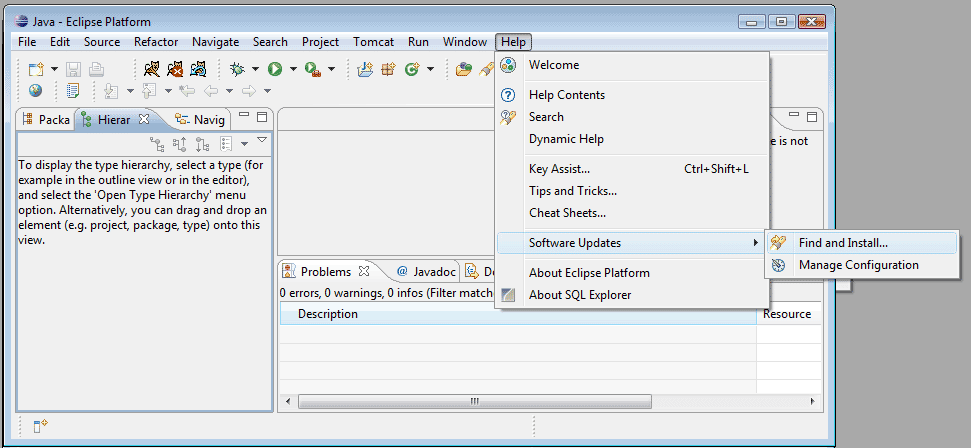
Figure 1: Access the Update Manager from HelpSoftware UpdatesFind and Install

Figure 1: Access the Update Manager from HelpSoftware UpdatesFind and Install

Figure 2: Select Search for new features to install in the Update Manager Options

Figure 2: Select Search for new features to install in the Update Manager Options

Figure 3: Add the PMD URL to the Site List

Figure 3: Add the PMD URL to the Site List

From this point, the standard “Next, Next, Next” steps can be easily followed. Upon success, you will have a new perspective in your workbench:

Figure 4: The PMD Perspective

Figure 4: The PMD Perspective

If you happen to use the PHP version of Eclipse you will need to accept the restart Eclipse option or be annoyed by prompts telling you that your workspace is a mess.

Checking Your Code with PMD

While PMD can be customized to meet your coding standards, you can start using it immediately after installation with the default configuration. For those who don’t already have documented coding standards, these defaults can provide a good starting point.

PMD allows you to check code at any level available in the code view, i.e., at the project, package or class level. The code check is run by right clicking on the code level you wish to check and selecting Check Code with PMD from the PMD options:
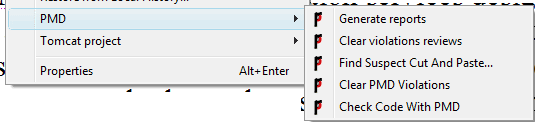
Figure 5: PMD Options in Right-Click Menu

Figure 5: PMD Options in Right-Click Menu

The location and number of violations is then displayed in the PMD view.
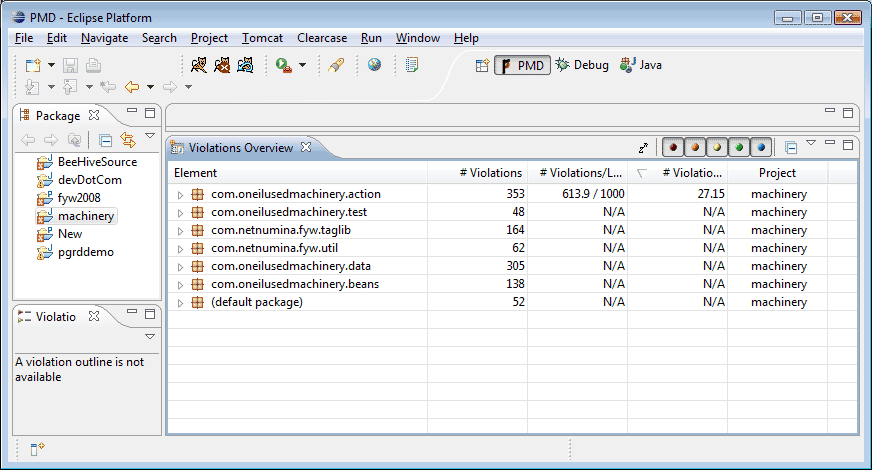
Figure 6: Check Code with PMD Results

You can drill down in the Violations Overview from the level you ran the check at all the way to individual line and violation description.

If you are introducing PMD mid-stream into a large project, the scan can take a long time. Once PMD has become part of your regular coding environment, getting in the habit of running a scan on each class you have created or updated prior to checking it into source control can save hours of bug hunting, not to mention reducing the possibility of embarrassing comments during code reviews.

After running a code check, the results can be exported by selecting Generate Reports from the PMD menu. A new folder will be added to your project named “reports” where the output will be available in several different formats.

Another cool feature is the ability to search for duplicate code with the Find Suspect Cut and Paste menu selection. The results of this search can help to pin down repeated code that should become part of a utility class.

Customizing PMD

If one reason for messy code is the differing opinions of what constitutes clean code then the expectation that the default rules will be perfect for every project is a bit ambitious. The PMD project takes this into account by making it very easy to customize which rules to enforce and what level of attention they should be given.

The basic view generally won’t need to be changed:

Figure 7: Basic PMD Option

The predefined rules can be edited and removed easily in the preferences view. Changing descriptions to match the text of your coding standards can make the standards themselves easier to remember. As running the code check becomes more of a habit, most developers will tend to have fewer violations as correcting them reinforces remembering how to code to the standards.
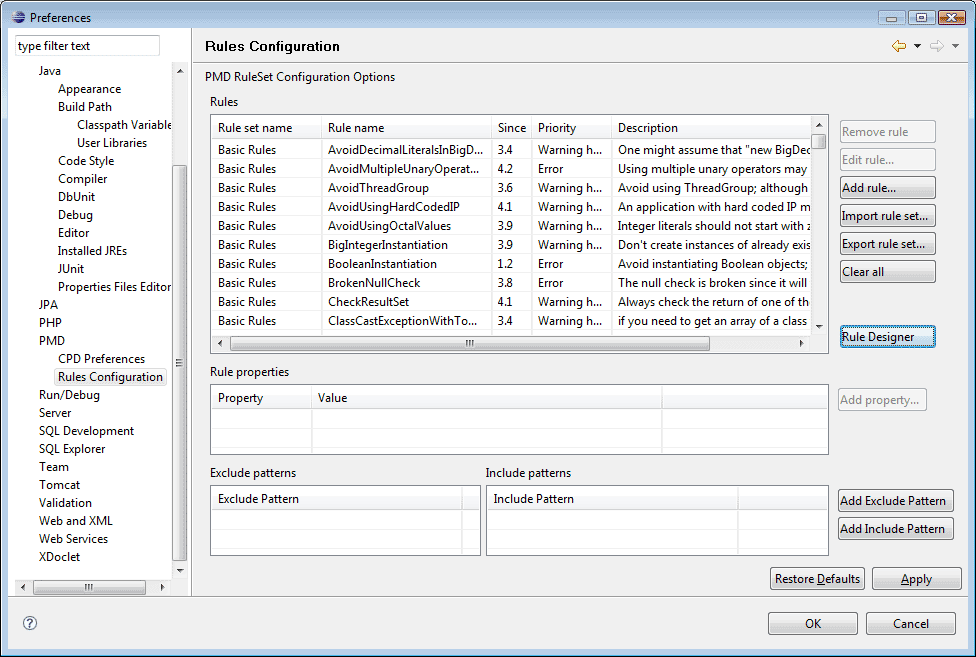
Figure 8: Customize Rules with Configuration

Figure 8: Customize Rules with Configuration

One key option is the violation level. In the code check results view there are color coded toggles to set what level of violations to show (see Figure 6). When time for code review is limited, selecting the higher priority level (lower numbered) violations can help developers and reviewers focus on the most urgent violations.

When determining what level a violation should be it is a good idea to avoid the temptation to go too high as the top level violations will prevent compilation of code.
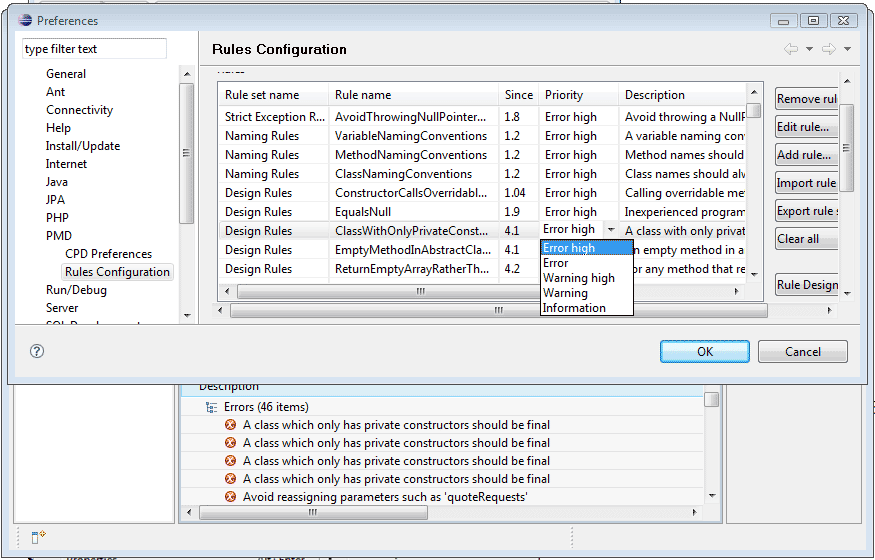
Figure 9: Error High Prevents Compilation

Figure 9: Error High Prevents Compilation

If you are adopting PMD mid project, setting too many violations at the highest level can bring project progress to a screeching halt or drive developers to remove the plug in, both results defeating the purposes of improving quality while saving time. However, if PMD is part of your environment from the first line written, high violation settings can lead to improved code quality throughout the project.

PMD also allows for creating your own rules, a task that is far beyond the scope of this article. Full documentation is available at http://pmd.sourceforge.net/howtowritearule.html. Most teams will find that customizing the descriptions and priorities of the large selection of pre-defined rules will be more than adequate for their needs.

Once the rules have been customized to match your standards, they can be exported for sharing across the enterprise or team.

While the tool itself is simple to install, customize and use, creating practices and policies to get the most of its use may take a bit more work. My personal preference is to make sure all violations at all levels have been addressed prior to the completion of the QA phase. Even with the best-defined rule sets, there will be some exceptions to the rules, and the project allows for this by providing a “Mark as reviewed” option. Using this option adds an annotation at the end of the line of code that will allow the code check to skip that violation in future checks.

Conclusion

PMD is a great tool for improving code quality, developing good habits and speeding up code reviews. It is not a panacea that can completely replace manually reviewing code. Code is an art as well as a science and automated tools have a long way to go before a level of heuristics that can be 100% reliable will be reached.

About the Author

http://www.linkedin.com/in/enterpriseportalarchitect/

If you found this interesting, please share.

© Scott S. Nelson

Techniques to Prepare for and Pass the TOGAF® Certification Exams

There is a great deal of discussion at the various virtual gathering places of Enterprises Architects (and those that want to be) on what certifications are the most important to have. The answers vary a great deal, mostly depending on perspective. Those who are already EAs respond with the assumption that everyone has almost as much education, experience and influence as they do, and recommend the pursuit of areas that will enhance their abilities. Then there are those who own a particular framework who suggest that the certification they offer is the most desirable for any EA (which I sometimes agree with except for the “most” quantifier). Then there are the practical bunch that point out that TOGAF® is the most widely recognized certification and the framework that many of the others are based on. In essence, if you are competent in TOGAF® you can easily become competent in most other frameworks.

Background

Once someone suggests TOGAF®, the thread moves to how to pass the certification (though many other threads about other frameworks and why certifications don’t matter will continue even though the original poster is ignoring them by this point). I recently achieved TOGAF® certification, and wanted to share how I did it before I catch the disease that seems to affect many TOGAF®-certified EAs where they mutter about how easy it is and just take a course or read a book. I also like to write, so you’ll have to suffer through some of my prose to get everything that worked for me (and some things that didn’t).  However, if you are as impatient with my writing as I am with most others, you can skip to the end for the outline and links. Go ahead, it won’t hurt my feelings…much.

I’m also not going to go into a deep review of the exam structure or material covered. This is more about where to get the material and how to use it than the material itself. The structure of the exam will be reviewed in terms of how to approach in a manner that will help you pass, and the material will only be referenced at a high level for context.

While I have worked with enterprise architecture for a dozen years, it has always been with the various custom frameworks of clients and employers (when any at all) which tend to use internal terminology and definitions. For example, one employer labeled “Information Architecture” as the practice of how users interact with information and focused on the use of wireframes, navigation and content taxonomy. Another employer referred to “Information Architecture” when they were discussing the design, designation and distribution of data and its containers. Neither organization listed “Information Architecture” in a glossary, so if you didn’t happen to already know their definition you could become very confused (and appear very stupid) in discussion about “Information Architecture” and the organizations capability to contribute Subject Matter Experts on the topic. Having been confused and appeared stupid in training class for an employer’s internal Enterprise Architecture Framework over this difference in nomenclature, when the time came to chose between TOGAF® Level 1 training and TOGAF® Level 1 & 2 training, I opted for the first. For my particular learning style, this was a good choice, even if made for (perhaps) the wrong reason.

Approaches

If your learning style leans towards interactive exchange with an instructor and other students or you have no experience with TOGAF®, I would highly recommend taking a Level 1 class as a starting point. Level 1 focuses mostly on the terminology of TOGAF®. In TOGAF® terms, Level 1 is the Preliminary phase of the ADM. The Level 1 exam covers all phases of the ADM, and touches on all of the other sections to assure that an individual certified at this level can have a conversation about TOGAF and not be totally lost. The exam is multiple choice, and the questions are at least twice as hard as any of the practice exams I have seen. So if you opt for the classroom instruction, review the course materials thoroughly afterwards. Many courses will give you the exercises performed during the class broken out by sections. I found it helpful to repeat the exercises to note which areas I did not score perfectly in and review those topics again.

If you are one of those people who absorb information very quickly or have been following the actual TOGAF® approach in your day-to-day work, going straight to a combined Level 1 and Level 2 class will probably be more to your liking and benefit. Level 2 of the TOGAF® exam and certification is a deep dive into how to take all of those terms and apply them in real-world scenarios. Level 2 is an open book exam, where a scenario is presented, a challenge is described based on the scenario, and then four approaches are described and your job is to pick the best one. One of the four is totally wrong, and the others have degrees of correctness. The training class I attended had us answer the class exercise questions by putting them in order. While this is not how the exam is done, I found that approach very helpful in choosing the most correct answer on the actual exam. One exam approach that I found invaluable was to break down the question into TOGAF®-specific areas and then see which answer addressed the most of them according to the document.

Don’t let the open book aspect of the Level 2 exam fool you into complacency.  While it does not have the rote memorization aspect of the Level 1 exam, the answers all sound pretty reasonable if taken alone. Also, for those who have dealt with Enterprise Architecture where TOGAF® was not followed some of the answers that sound most real-world are the 0 point responses. The key to this part of the exam is to know the structure of the TOGAF® document so that you can quickly locate relevant sections and verify how closely an answer matches the document. Another point to remember is that in addition to the document, there is a general approach core to TOGAF® which is the collaboration between business, technology, Enterprise Architecture and Project Management.

Of course, there are those who learn perfectly well from only reading (or reading in addition to work experience) and they are welcome to ignore my training course recommendations. In fact, for simply passing the certification exams (as opposed to scoring well, which I have a preference for), you can get by without a course, too, if you follow all of the suggestions described here using the written material and any practice exams you can access.

I would highly recommend taking the exams separately as I experienced some dismay during the Level 2 exam as I noticed which answers I got wrong on the Level 1 exam, which is a distraction.

Planning is Everything

One note from my personal experience is that having taken the path of a Level 1 course and certification followed by a combined Level 1 & 2 course (there was no Level 2-only course available to me at the time) I assumed that I would be able to simply take the Level 2 exam to complete my full TOGAF® certification. Turns out I need to have discussed this with the training company before taking the course as I received a voucher for the combined exam instead of just the Level 2. I could not exchange the voucher, and the testing center would not allow me to take only the Level 2 with that voucher, even though I had taken the Level 1 course with the same training company and the exam with the same exam provider. Fortunately I don’t know if this rigid process would have resulted in my not having been certified if I failed the Level 1 exam the second time around, though I’m sure it would have entailed a great deal of time consuming communications to correct that situation had that been the case. I suppose it is very much in the spirit of TOGAF® to never assume that all parties think about the same model from the same viewpoint.

My Ultimate TOGAF® 9 Certification Preparation Process by the Numbers

OK, so here it is, as promised:

Before the exam…

  1. Read TOGAF® 9 Certified Study Guide
  2. Attend a course
  3. Read the TOGAF® 9 spec cover to cover
  4. Review the course materials

During the exam…

  1. If possible, take the Level 1 exam and Level 2 exam individually
  2. If not 100% positive about the answer, mark it for review
  3. For Level 1, do not spend more than two minutes on any question for the first pass
  4. Complete all answers in the level before reviewing
  5. If you don’t know an answer pick one at random and mark it for review
  6. Once completing all the answers, begin the review with the first question. Some of the answers will now be obvious from later questions, so go through the marked questions quickly the first review and answer the ones you know are confident about
  7. On the first review, do not spend more than 1 minute per question
  8. If not 100% certain, leave marked for review
  9. On the second review, take your time and answer to the best of your ability, leaving those you are not 90% sure of marked for review
  10. Review until you run out of time
  11. For Level 2, list the parts of the question that map to TOGAF® then check each answer for addressing those items. The one that addresses most of those items is the most likely answer

Conclusion

In all honesty I can’t say that any one source for how to pass the exam is going to work for everyone capable of passing. I hope that I have given you one of the better approaches, including the suggestion to look for blog entries and articles and discussion that have further tips specific to your needs. What I have described here worked very well for me, with the key advice I found at one site being to look for the answer that was the most TOGAF®-ish and that was generally the best answer. The studying approaches I described are what allowed me to apply that excellent advise.

Other Resources

If you found this interesting, please share.

© Scott S. Nelson