Quick summary: Transforming IT from a cost center to a profit center starts with more strategic business decisions concerning technology.
There are parts of IT that are costs, such as vendor-provided platforms, and this may confuse some into lumping all of IT into the cost center bucket. IT can (and should) be a profit center. Efficient IT can improve profit margins and growth. It is the business practices and decisions to treat IT as a cost center that eventually turn it into one.
Just as applications are useless without users, Enterprise IT that doesn’t provide value eventually won’t have an Enterprise to provide value for. What is often forgotten is that business capabilities are only as reliable as the processes that support them, including Enterprise IT processes. Many may believe that technology companies are the fastest and strongest in the market because they are more valuable, and I believe they are more valuable because they understand the value of technology and treat it as an investment rather than a cost of doing business.
Comparing Apple™ to apples
The difference in the nature of products fosters the confusion. A widget (or apple, to clarify the subheading) company that has a failure in the manufacturing process can go bankrupt, whereas a software company that has a defect can just issue a patch, ergo, issues with software are less important than issues with other enterprise activities. The misconception is that the software product is the same as the enterprise software that distributes it or the systems that communicate with customers. If that enterprise software fails for either the software company or the widget company, they are going to have a bad quarter (or worse). Tech companies know this, and it is why so many that run at a loss for a long time are later the biggest players. A deeper look into companies not considered as technology companies will show that the highly successful ones treat their Enterprise IT systems as if they were technology companies.
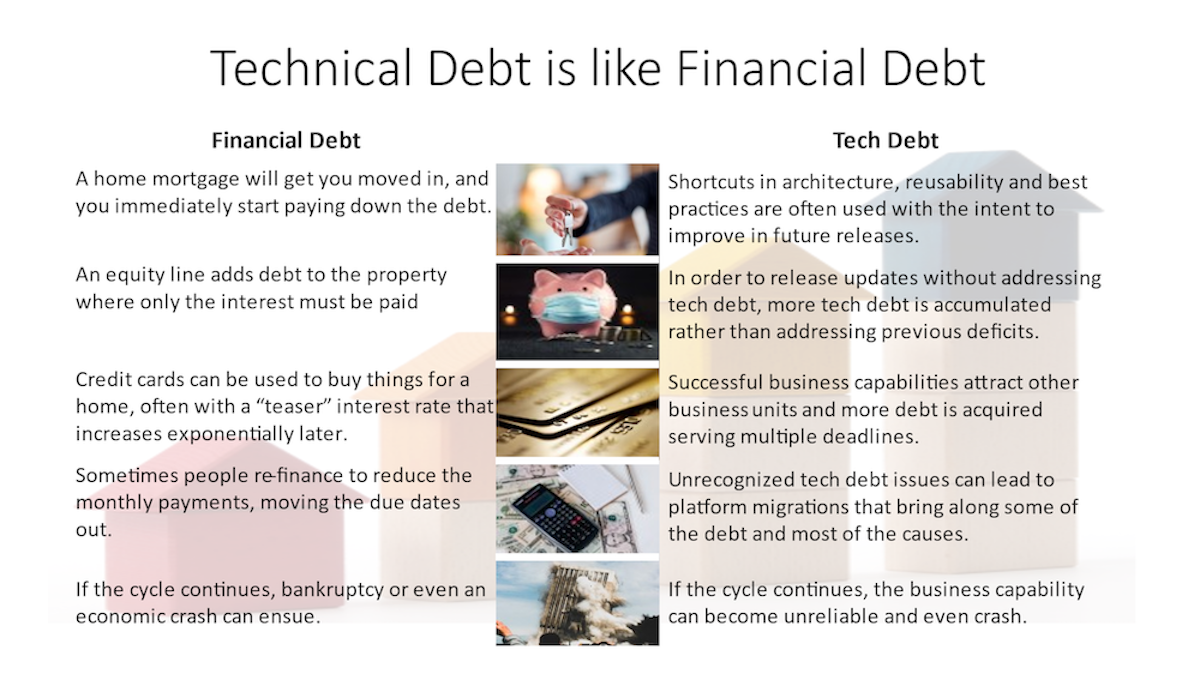
A clear indication of a company misunderstanding the value of their enterprise systems is the accumulation of technical debt. Technical debt is the result of Enterprise IT taking shortcuts to meet business objectives. For widget companies, or even widget service companies, this seems like a good trade off, because widgets are more important than enterprise systems to a widget-based company. Like any debt, technical debt grows exponentially when the principle is not paid down. True, that is not how math works, but it is how debt works, because the same attitude towards debt that focuses on interest payments and not the principle also tends to acquire more debt in other areas—or attempts to address the debt by restructuring it into new debt that is larger because there is a cost to the restructuring.
Getting interested in debt
The debt is a result of treating shareholders as Enterprise IT stakeholders. The business is the stakeholder, and while the shareholder may be a stakeholder in the business, it is the responsibility of the business to do what is best for shareholders by seeking ways to increase value in a sustainable manner. Enterprises that are spending money on paying loan interest are not giving that money back to the business and the shareholders. Eventually, this will erode share value.
The cost of technical debt is that expanding business capabilities takes longer or costs more or both. Unmanaged technical debt reduces quarterly earning capabilities, sometimes exponentially in relationship to value realized. Eventually, the debt becomes “real” enough that the business takes notice and invests in dealing with it…or an organization with a much lower level of technical debt takes over the company and enjoys the profits of applying their own solid, stable infrastructure to selling widgets in addition to their other successful enterprises.
“Lies, damned lies, and statistics”
Another perspective that leads to technical debt and higher IT costs is quarterly reporting. IT in the profit column puts a focus on ROI and a culture of seeking efficiency in providing new and improved features. If IT is in the cost column, cutting costs sounds good on the quarterly report, but what reduces IT spending in one quarter will increase the cost in a future quarter, both in maintenance and impact to further growth initiatives. Technical debt is less of a metaphor than an understanding of the true monetary value of IT.
Some may take the viewpoint that the need to update IT periodically is an argument for it to be considered a cost center. That need is (generally) driven by two things: the accumulation of technical debt making it cheaper to replace, or an improvement in the technology that makes an update even more profitable. To be fair, this misunderstanding is exacerbated because there are many initiatives that claim to be driven by the latter when the root motivation is the former.
Bottom line
Thinking of shareholders as IT stakeholders is a recipe for fragility. If technology is not improving profitability, then it either needs to be updated or discarded for the right technology. The only way to cut costs in the long term is to invest in reversing technical debt from previous quarters and reap the rewards in next quarters.
Originally published at https://logic2020.com/insight/it-cost-center-or-profit-center/
If you found this interesting, please share.