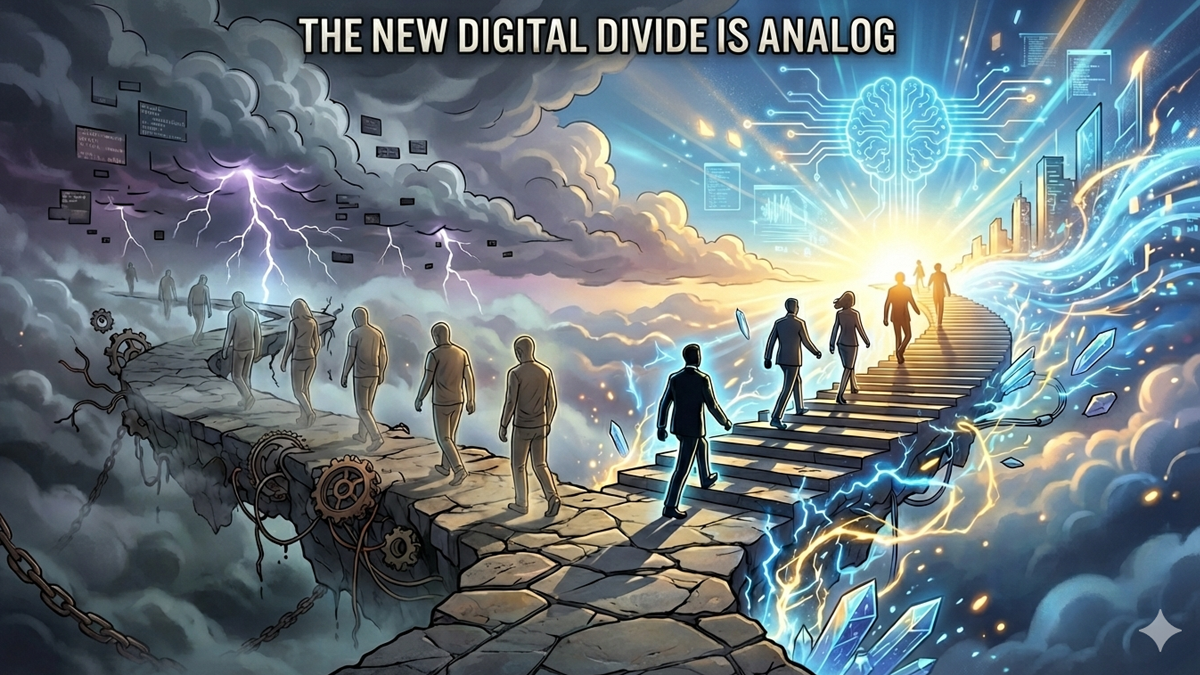
The Beginners Mind Stands on a Foundation

TL;DR: Experience is a liability when it kills curiosity. AI proficiency is a byproduct of hundreds of hours spent in invisible iteration.

The Expertise Trap

Deep experience often triggers intellectual rigor mortis. You have seen the “right” way to do things for a decade, so you stop looking for the better way. A beginner mindset is not about being a blank slate (which is just another word for useless). It requires enough of a foundation to know when you are headed in the right direction, or perhaps a parallel path with new perspectives, before getting back on track.

If you have twenty years of experience but no curiosity, you are just a legacy system waiting for a decommission date. The ROI on a “beginner” attitude is higher because it allows for rapid pivoting. You need the basics to provide a compass (to avoid spending days debugging a syntax error), but you need the mindset to explore the paths that lead to breakthroughs.

The AI Sweat Equity

There is a myth that prompting is a low-skill activity. It is not. Most people really good at prompting have iterated and learned. The developers currently running multiple agents and building software 4 to 10 times faster than they did last year have been in months of practice to get there.

This is iteration 0 work. It is messy and mostly undocumented (because the tech moves faster than the README files). What makes it daunting for those first starting is that the people who are now good at it did it without formal training. There is a tendency to forget how much effort went into the initial struggle.

Building the Mental Infrastructure

Learning new technical skills requires toggling between different cognitive states. Barbara Oakley (author of Learn Like a Pro: Science-Based Tools to Become Better at Anything and Learning How to Learn, among other great books) describes this as the tension between focused and diffuse modes. Focused mode is for the granular syntax: the structure of a prompt or a script. Diffuse mode is where the beginner’s mindset lives. It is the relaxed, curious state that allows your brain to make the non-linear connections required to solve a problem that does not have a documentation entry yet.

She emphasizes chunking: breaking complex concepts into small, functional units until they become second nature. This prevents cognitive overload when the system throws an error you have never seen before. Curiosity is a tool that keeps you in the diffuse mode long enough to see the “big picture” before diving back into the details. I took her class on Coursera at the start of my AI journey, and I recommend everyone do the same, even if your interests are in other areas. It applies to learning anything, and you will thank yourself for doing so.

They say “oh, it’s easy, you just do this”, which looks like magic to the beginner. It is not entirely different from visiting a new area and asking a local for directions. Every time they start with “Oh, that’s easy”, there is a good chance you are going to get lost following their directions.

Locals navigate by landmarks that either do not stand out to an outsider or have disappeared from all but the local’s memories. They tell you to turn where the oak tree used to be or past the shop that changed names five years ago. They have internalized the route so deeply they forget the friction of finding it the first time.

And sometimes, that makes the trip more fun. Stop looking for the “perfect” prompt or the “right” workflow. Spend more time being “lost” in the tool. The goal is not to avoid the detour: the goal is to have a strong enough foundation to know how to get back to the main road once the detour stops being productive.


A Simple Roadmap

If you haven’t begun your journey with Generative AI, or feel a bit lost, here’s a simple roadmap to help you along:

  1. Pick one model and stay there: Stop comparing benchmarks and just use one tool (Claude, GPT, or an LLM via API) for a week straight to understand its specific “personality.”
  2. Iterate on a single prompt 50 times: Don’t just accept the first output. Change one variable at a time until you understand exactly what triggers a hallucination vs. a logic block.
  3. Read the system prompt documentation: Most users treat AI like a search engine. Read the actual technical guides on “system roles” and “temperature” to understand the controls.
  4. Practice manual orchestration: Before you try to automate a multi-agent system, act as the agent yourself. Copy the output of one model into another and manually fix the “gotchas” in between.
  5. Fail on purpose: Try to make the model break. If you don’t know the edges of the tool, you won’t know when you are standing on a cliff.
If you found this interesting, please share.

© Scott S. Nelson

Zen and the Art of AI Adoption: Surviving the Scare Trade to Thrive in the Age of AI

“the AI scare trade is speeding up AI transformation by years at tens of thousands of businesses.” (Nate B. Jones, Feb 19, 2026, Why the Biggest AI Career Opportunity Just Appeared—and Almost Nobody Sees It.)

Anyone who is focused on enterprise AI adoption and heard this on Nate B Jones‘s AI News & Strategy Daily channel or read it on his substack will be concerned about how this all works out on several levels. Let’s look at a few key impacts:

  • Your Investments
  • Your Career
  • Your Business

That list is not in order of importance; it is in order of a sequence of events in history where each of these aspects has had similar drivers. I will be referring to quotes from Why the Biggest AI Career Opportunity Just Appeared—and Almost Nobody Sees It. throughout, and I recommend you watch it after reading this because it has a lot more to offer on other topics, too.

Investments

While I agree that last year was not the AI bubble, there is one coming soon. Anyone that was part of the world of tech in 2000 will see the echo here:

Meanwhile, AI startups, regardless of whether they’re good or not, look relatively more attractive to everybody. You stick AI in the name, and magical things happen right now. Magically, more capital will flow to the AI company that has AI in the name and releases an AI press release than to anybody else. (14:23)

In 1999, companies with “.com” in their name were guaranteed a huge IPO, even if all they had to offer was a cool sock puppet as their mascot. Today, a similar narrative is forming where Wall Street hype and Media hype are creating a hype-vortex, drawing in capital regardless of actual value. When the Dot Bomb blew up the Dot Com Bubble, I watched friends near retirement age having to change their life plans with no choice because it wasn’t just tech stocks that took the hit, and it took the market 15 years to rise back up to the peak of the previous century. Diversification was not a watchword in those days; even for those that were diversified, the impact rippled.

Your Career

…the CFO pulling forward cost cuts to demonstrate to investors that management does take this transition seriously. Stock drop doesn’t just reflect reality, it creates reality. A company whose stock craters on AI fears is going to start behaving as if AI is an existential threat. Even if the actual tech is years away from threatening its core business, defensive postures get adopted right away. (4:58 to 5:19)

Lots of people have already had their lives upended by companies determined to show investors that they are becoming more efficient, even (especially?) if they aren’t. This reactive stance often ignores the fundamental reality that human behavior does not move at the speed of a GPU (see Your AI-Driven Digital Transformation is Impeded by Behavioral Challenges).

There are lots of takeaways from the video on this, so, again, watch it after reading this. Meanwhile, a recurring theme on the channel is that if you aren’t thinking about how you can learn to use AI and then figure out how to become more efficient with AI, your career is going to be in trouble. This will come later for some industries as a whole, and for individual businesses because, contrary to media hype, not everyone is going to be making the shift at the same time and certainly not at the same pace. But it is coming, and the speed it is coming at keeps increasing.

There were a lot of people who changed careers in the late 90s into a track that was tied to the .com boom. Only a few survived and then thrived in the rebuild. Of the rest, the lucky ones were able to resurrect their former skills and return to their previous work. The rest often drifted from job to job, sometimes finding a new track, and sometimes not.

Your Business

And because of the prominence of the American stock market, there are boards all over the world looking at this. Now visibility like this is what turns a slow trend into an urgent capital reallocation in favor of AI. I’m not kidding when I say the AI scare trade is speeding up AI transformation by years at tens of thousands of businesses. The scare trade is a transfer of career capital from the people who treated AI as somebody else’s problem to the people who have been invested in understanding it. (27:59 to 28:24)

The above quote is what inspired this post. I’ve been advocating for a while now that most businesses have been going all wrong about how they are adopting AI. They are buying the tools and then trying to figure out how to use them. This approach often fails to account for the competitive disadvantage smaller firms face when racing against the scale of industry giants (see Why Bigger Companies Move Faster than You in the AI Adoption Race).

Companies are looking at how others are using tools and assuming it is the tool that is making it work, so they start mimicking the behavior they can see and failing miserably because what makes the tools work is not the results, it is the process of adoption and growth. That is why for every Chase or Walmart example, there are 10 AWS or Replit incidents. Many of those don’t go reported because they happened to a business the size of yours, rather than one that is currently getting media focus on a regular basis.

It’s clear that some businesses are going to rush into their AI adoption approach. Some already have. Some will be like children that touch the hot stove (healing in a couple of weeks and exercising caution), and a few may even become great chefs. Others will be more like the fictional inventor from The Expanse, but without the rest of the world benefiting from his demise:

Lesson learned? Faster is better when you build speed, not when you jump straight from 0 to splat.

Post title inspired by both Zen and the Art of the Internet: A Beginner’s Guide and Zen in the Art of Archery. While the title Zen and the Art of Motorcycle Maintenance is the inspiration for the former, Zen in the Art of Archery is much more along the lines of this post and the AI adoption, though truthfully the adoption of AI, like your situation, is unique unto itself.

Looking for help adopting AI in your organization? Let’s talk. Tag me in a comment or reach out directly with a connection request.

If you found this interesting, please share.

© Scott S. Nelson
The New Digital Divide is Analog

Your AI-Driven Digital Transformation is Impeded by Behavioral Challenges

The recent article by CT Crooker, Why Everything You Know is Probably Wrong, is filled with hard truths that everyone in IT needs to consider. It starts by pointing out the evidence supporting the thesis that things are going to be very different.

“Going to be” is the one level where I depart from a lot of recent articles by really brilliant people. When discussing the unprecedented acceleration of new and improved capabilities that come under the media definition of AI, these experts are not only correct in their assessments of the rate of change; they understand the details of those changes better than most.

However, they often present these shifts as a present-tense reality for the masses. For the vast majority of organizations, these changes are still in the “going to be” phase because the experts are focusing on a very active and very small minority.

Then there are people.

  • Most CI pipelines aren’t really continuous and don’t truly integrate.

  • Teams hold stand-ups and manage backlogs that aren’t the least bit Agile.

  • Enterprise CRM systems are treated as glorified address books while the predictive analytics and automation features sit dormant.

  • Smartphones are used for scrolling while the powerful sensors and computing power in our pockets remain largely untouched.

The main impedance to technical solutions is rarely a technical problem. The real culprits are process and culture challenges that act as a silent brake on innovation. This resistance to change usually stems from a deep-seated fear of the unknown or a perceived threat to the status quo.

When a new capability arrives, it doesn’t just offer a faster way to work; it threatens the established hierarchy, the “way we’ve always done it,” and the specialized knowledge that individuals have spent years protecting. These psychological hurdles are the biggest obstacles to adding and improving technical capabilities. It will take significant time before these new tools make it into mainstream IT departments because human behavior does not move at the speed of a GPU.


A Challenge by any Other Name is…Entirely Different

This brings me to the point of my only contention with the article. I disagree with the suggestion that “transformation impedance” is a better way to think about these shifts than “epistemic flexibility under inversion.” While I find the shift in terminology problematic, Crooker’s post is otherwise incredibly thought-provoking and accurate; it is really valuable that he raised these points because they are essential to consider.

He explains “epistemic flexibility under inversion” as a capability characteristic of both systems and people to adapt to rapid changes and then adopt new approaches as a result. He goes on to suggest that “transformation impedance” may be a better way to think about it.

But branding is more important than most realize. People who take up the call of “transformation impedance” will be more likely to focus on the impedance side, which leads to conflicts between those who think everyone should reduce the impedance versus those who want to lower it. I’ll admit there is some room for collaboration on the rate of lowering impedance, but then again, there are still a lot of those CI pipelines that are still neither.

First, I will admit that I had to look up the definition of “epistemic flexibility under inversion” to fully digest it:

“Epistemic flexibility under inversion” is a specialized concept often found at the intersection of Bayesian statistics, cognitive science, and information theory. It refers to a system’s (or a mind’s) ability to maintain a coherent understanding of reality even when the “direction” of information flow or the relationship between cause and effect is flipped.

Once I had this better understanding, I had the same reaction to using “transformation impedance” as an alternative as I do to changing “issue” to “challenge.” (There is a lot more to that definition, of course, and I suggest you talk with your favorite Generative AI LLM to get the rest of the picture.)

The Utility of the Negative

Media tells us we should always be positive and pursue higher goals. We buy into this because the truth is that the method of using the negative to drive action, specifically addressing an “issue,” is much more likely to succeed than the message of chasing a dream. That’s another hard truth.

I like “issue” better than “challenge” because people will deal with an issue so it will go away. A challenge makes them feel good about pursuing it, and since the pursuit is the reward, completing it removes the reward and thus the incentive. If it is an issue, the incentive needs to be to correct it.

While “epistemic flexibility under inversion” may be harder to understand, it keeps the focus on how we need to change our approach to deal with the changes approaching us. “Transformation impedance,” on the other hand, is a label describing a phenomenon and doesn’t necessitate action until it is too late.

We need to flip our approach and find ways to catch up with change and not be left behind or run over. We should begin thinking about what problems need to be solved for our businesses, and even our lives, that for whatever reason we thought were too hard before, and then come up with new solutions taking advantage of the AI. To do that, we must be willing to set aside the old frameworks that impede our ability to do so.

If you found this interesting, please share.

© Scott S. Nelson
Utopia or Dystopia

The Frictionless Trap: AI’s Greatest Benefit is also a Hidden Risk

I’m a big fan of classic science fiction. I generally avoid dystopian themes, but some are just too good to ignore, from A Boy and his Dog to Hunger Games. When ChatGPT started getting all that popular press a few years back, I was looking forward to finally living in that shiny future promised by Heinlein, Asimov, Clarke, and Roddenberry finally coming true, maybe even a flying car (the current prototypes still aren’t there yet, BTW). But the news of the last few years has had more Brave New World and 1984 vibes.

So when I read a recent NPR report on AI in schools, it felt like another example of how we are engineering frustration out of the human experience. The report describes software that is so sensitive to a student’s frustration that it pivots the curriculum before they even have a chance to get annoyed. On paper, it is a triumph of user experience; in practice, it might be a silent deletion of the very thing that makes a mind grow.

The Lesson of the Eloi

When H.G. Wells sent his Time Traveller into the year 802,701, he didn’t find a high-tech utopia or a charred wasteland. He found the Eloi: beautiful, peaceful, and intellectually vacant creatures living in a world of total automation.

Wells’ speculation in his passage on [suspicious link removed] hits quite close to home in the age of generative AI:

“Strength is the outcome of need; security sets a premium on feebleness.”

The Eloi weren’t born “slow” because of biology. They were essentially optimized into that state by an environment that removed every possible hurdle. They had won the game of civilization so thoroughly that they lost the ability to play it.

The parallel to AI-driven education isn’t that the technology is failing, but that it is succeeding too well. If the machine handles every productive struggle (sensing your confusion and immediately smoothing the path), it isn’t just teaching you. It is doing the mental heavy lifting on your behalf. You don’t get stronger by watching your trainer lift the weights, even if the trainer is a hyper-personalized LLM.

The Mirror of “Useful” Atrophy

It isn’t just about the classroom; AI is becoming a universal solvent for friction. History suggests that when we remove friction, we usually lose the muscle that was meant to overcome it.

  • The GPS Effect: We traded the frustration of paper maps for a blue dot that tells us where to turn. The result is that our internal spatial awareness is basically a legacy system. We can get anywhere, but we often have no idea where we are.

  • The Calculator Trade-off: We offloaded long division to a chip. This was a fair trade for most, but it established the precedent: if a machine can do it, the human brain is officially off the clock for that specific skill.

  • The Infinite Search: We stopped memorizing facts because we treat our devices as an external hard drive for our personalities.

Not all of that has been a bad thing, unless we get to live one of those post-EMP stories (which I avoid reading to avoid remembering it isn’t that far-fetched). I, for one, am glad that Einstein said “Never memorize something that you can look up,” because rote memorization is a struggle for me, but I really do enjoy exercising mental muscle memory. Which is where using AI the wrong way will lead to an atrophy that doesn’t need a major solar event to make us realize things went too far. It doesn’t just provide answers; it simulates the thinking.

The Verdict: Designing for Resistance

We should be optimistic about AI’s potential to amplify us, but we have to be wary of the passenger mindset. If we use these tools to abolish difficulty, we aren’t empowering ourselves. Instead, we are prepping for a very comfortable life as Eloi.

The challenge for educators, and for anyone using an AI “intern” in their daily workflow, is to intentionally design productive friction back into the system. We need AI that makes the work more meaningful and not just more invisible.

Mastery requires resistance. If the road is perfectly flat and the bike pedals itself, you aren’t traveling; you are just being delivered.

If you found this interesting, please share.

© Scott S. Nelson

Why Bigger Companies Move Faster than You in the AI Adoption Race

It’s not because they are more innovative.

There is a common myth in tech that smaller, nimbler companies always win the adoption race. But with Generative AI, we are seeing the opposite. While startups are still “tinkering,” enterprises are productionizing. According to recent data shared by Nathaniel Whittemore (a.k.a. NLW, host of the AI Daily Brief & CEO, Super.ai) at the at the AI Engineer World’s Fair, full production deployment of AI agents in billion-dollar enterprises jumped from 11% to 42% in just the first three quarters of 2024 [03:15]. Why? It comes down to a brutal reality of economics, automation, and what I call the “2% vs. 20% ROI Gap.”

AI is Automation (Just Less Consistent)

Many AI enthusiasts argue that automation isn’t AI. That’s true in the sense that not all fruits are apples, but all apples are fruits. AI is automation. The primary difference? Traditional automation is deterministic (consistent); AI is probabilistic (less consistent, but more capable). Smaller companies are already masters of traditional automation because they have to be. They use it to survive with fewer people. But for a massive corporation, the “low-hanging fruit” of basic automation hasn’t even been picked yet. This creates a massive opportunity for Information Gain—the ability to apply AI to “messy” processes that were previously too expensive to automate.

The Math: The 2% vs. 20% Rule

The biggest “moat” for big business isn’t their data or their brand—it’s their Scale ROI. Because a large company doesn’t need significantly more resources than a small company to build a single AI agent or workflow, the math of deployment looks very different:

  • For the Small Business: To pay for the initial R&D and resource overhead, a new AI tool might need to deliver a 20% improvement in efficiency just to break even.
  • For the Enterprise: Because they are applying that tool across thousands of employees or millions of transactions, a mere 2% improvement creates an ROI that justifies the entire department.

Furthermore, as NLW points out, these large organizations are moving toward Systemic Adoption [17:00]. They aren’t just doing “spot experiments”; they are thinking cross-disciplinarily. They can afford to go slower, spend more on high-quality resources, and leverage volume discounts that drive their production costs down even further.

The “Risk Reduction” Transformation

Interestingly, while most companies start with “Time Savings” (the default ROI metric), the real “transformational” wins are happening elsewhere. NLW’s study found that Risk Reduction—while the least common primary goal—was the most likely to result in “transformational” impact [14:59]. Large companies have massive back-office, compliance, and risk burdens. AI can handle the sheer volume of these tasks in ways a human team never could [15:17]. This is a “moat” that small businesses simply don’t have to worry about yet.

The Cycle: From Moat to Commodity

This scale is the moat that gives big business a temporary advantage. But here is the irony: The more they use that advantage, the faster the moat shrinks. As enterprises productionize these efficiencies, they effectively commoditize them. What cost a Fortune 500 company $1 million to develop today will be a $20/month SaaS plugin for a small business tomorrow. We are in a cycle of:

  1. Hype: Everyone talks.
  2. Value: Big companies productionize at scale.
  3. Cheap: The tech becomes a commodity.
  4. Reverse Leverage: Small, disruptive players use those same cheap tools to move faster and out-innovate the giants.

The giants are winning the production race today, but they are also building the very tools that the next generation of “disruptors” will use to tear them down.

If you found this interesting, please share.

© Scott S. Nelson