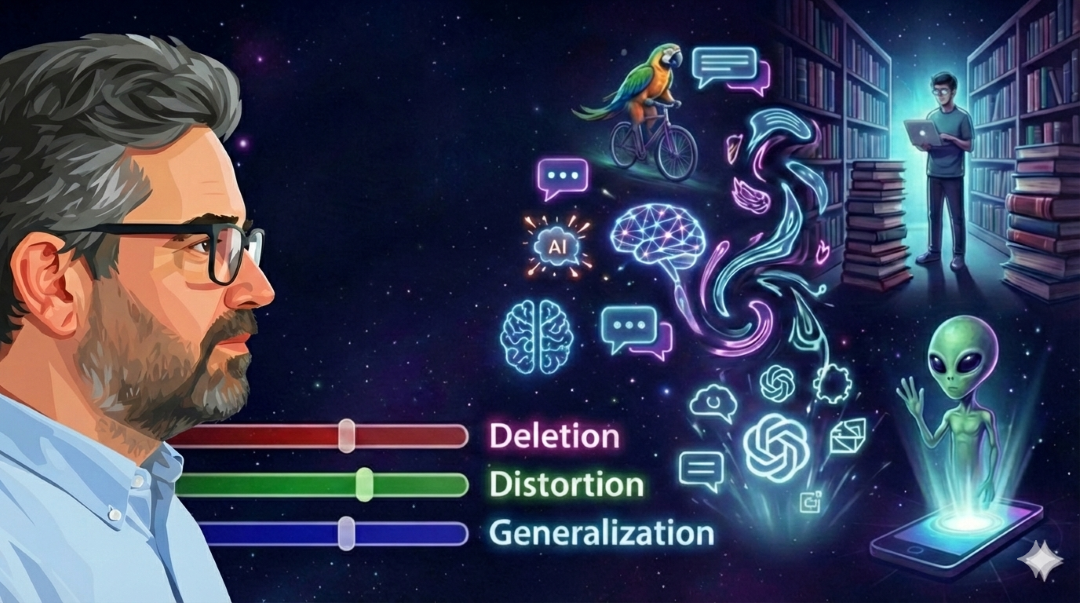
MLL: Metaphorical Language License

That headline is an epic fail at being clever. Clearly no AI there. Going to go with it anyway to make a point or two.

Human perception is just a collection of filters. Adjusting for “Red,
Green, and Blue” in an image is no different than how our brains handle
new tech through Deletion, Distortion, and Generalization.

The AI hype bubble is the ultimate stress test for these filters.

Human Perception as
Filtering

The first point is, human perception is the result of filtering.
Actually, all perception is the result of filtering; it is just that
humans are more interested in how it affects them. That is actually part
of the filter.

Sort of like image filters, where you have adjustments for Red,
Green, and Blue, perception is adjusted through deletion, distortion,
and generalization. Some examples:

  • Deletion: Everyone has at least one thing they do
    where they wouldn’t do it if they remembered how difficult it was.
  • Distortion: Media algorithms that zoom in or out
    based on audience bias.
  • Generalization: The core of most learning and both
    a boon and barrier to that very learning.

While generalization is core to individual learning, all three
filters can be seen when groups of people are learning. Here is how
those filters are dialed at a group level:

  • Deletion: Things we learned in the past that would
    help us better adopt and adapt to what is a new paradigm in
    technology.
  • Distortion: Knowledge distribution through media
    algorithms that zoom in or out based on audience bias.
  • Generalization: Comparing new paradigms to
    previously familiar concepts; being exposed to high-level concepts as
    parallels to common knowledge to build on iteratively, going deeper each
    time.

The AI hype bubble is a perfect example of the above perceptual
filter settings.

Metaphors for AI Perception

Taking this back to the headline, an anadrome of LLM, here are five
common metaphors being applied to AI (and organized by AI, TBH) that are
worth adding to your own perceptual filters:

  1. The “Alien Intelligence” This metaphor suggests
    that AI doesn’t think like a human; it is a powerful, non-human mind
    that we are trying to communicate with. It highlights the “otherness”
    and unpredictability of Large Language Models (LLMs). Best
    for
    : Discussing AI safety, alignment, or the surprising ways AI
    solves problems. Source: Popularized by technologist
    and writer Kevin Kelly in Wired, where he argues we should view AI as an
    “artificial alien” rather than a human-like mind.
  2. The “Stochastic Parrot” This is a more critical
    metaphor used to describe LLMs. It suggests that AI doesn’t “know”
    anything; it simply repeats patterns of language it has seen before,
    much like a parrot mimics sounds without understanding the meaning.
    Best for: Explaining how LLMs work, discussing
    hallucinations, or tempering over-hyped expectations.
    Source: From the influential 2021 research paper “On
    the Dangers of Stochastic Parrots,” co-authored by Emily M. Bender and
    Timnit Gebru.
  3. The “Bicycle for the Mind” Originally used by
    Steve Jobs to describe the personal computer, this metaphor has been
    reclaimed for AI. It positions AI as a tool that doesn’t replace the
    human, but rather amplifies our natural capabilities, allowing us to go
    “further and faster.” Best for: Productivity-focused
    content, tutorials, and “AI-as-a-copilot” narratives.
    Source: Originally Steve Jobs (referring to PCs);
    recently applied to AI by figures like Sam Altman (OpenAI CEO) in
    various interviews regarding human-AI collaboration.
  4. The “Infinite Intern” This metaphor frames AI as
    a highly capable, tireless assistant that is eager to please but lacks
    common sense and requires very specific instructions (prompting) to get
    things right. Best for: Business use cases, delegation,
    and explaining the importance of “human-in-the-loop” workflows.
    Source: Widely attributed to Ethan Mollick, a Wharton
    professor and leading voice on AI implementation in education and
    workplace settings.
  5. The “Electric Library” Think of AI not as a
    search engine that gives you a list of links, but as a librarian who has
    read every book in the world and can synthesize that information into a
    single answer for you. Best for: Explaining the shift
    from traditional search to Generative AI search.
    Source: A common conceptual framework used by Ben
    Evans, a prominent technology analyst, to describe the shift in how we
    access and process information.

However you perceive the rise of LLM-based AI, include “Springboard”
in your own collection of metaphors. That is, something that helps
anyone reach higher when approached at high speed with focus…and will
trip you if you come at it the wrong way, even at a slow walk if not
paying attention.


This post was inspired by a post on LinkedIn by Dr. Thomas R. Glück. If
you have read this far, please like, comment on, and share both.

If you get all the way through this post, please
tell me if the “MML” headline is an epic fail at being clever or if it
caught your eye. (Full disclosure: I use a Gem to review and edit my posts, and
generally ignore 80% of what it suggests, including losing that
headline.)


If you found this interesting, please share.

The Collaboration Dividend: Who is really ahead in the GenAI Adoption

I’ve seen several tech buzz cycles, where even the real stuff is hyped. From BBS systems to .com bubbles, shareware to SaaS, DHTML to AJAX to ReST, and web first to mobile first to cloud first. In almost every one of those booms, the “first-mover advantage” belonged to the command-and-control mindset: direct, rigid, and strictly instrumental.
As I watch the rolling adoption of Generative AI (GenAI), I see a long-overdue validation of a different skillset.
The technical gap is no longer being closed by the most aggressive “commanders,” but by the most collaborative coordinators. I am delighted to see that women are not just adopting this technology, they are mastering its productivity curve at a rate that confirms what many of us have suspected for years:
When technology becomes conversational, the best communicators win.

A Predictable Shift in the Trenches

In hindsight, this was inevitable. We have moved away from a world where you had to speak “machine” (syntax and code) to a world where the machine finally speaks “human” (semantics and dialogue).
I’m seeing this play out in two very specific ways:
  • In Engineering: I’ve noticed women developers are often faster to move past using AI as a simple code generator. They are using it as a high-level architectural partner, stress-testing logic and managing edge cases. They aren’t just looking for an output; they are managing a relationship with a complex system.
  • The Non-Technical Leap: This is one of the most gratifying shifts to watch. I’m seeing women in marketing, HR, and operations become “technical” as a side-effect of AI adoption. They are building automated workflows and custom tools that once required a dedicated IT ticket. They are bridging the gap not through brute-force coding, but through precise, collaborative inquiry.

Why the “Soft” Skill is the New “Hard” Skill

Traditional computing was about giving a machine a rigid command. If you didn’t know the exact syntax, the machine failed.
GenAI is different. It requires a dialogue.
The best results don’t come from a single prompt; they come from a back-and-forth “coaching” session. This requires empathy for the model’s logic, iterative questioning, and the patience to refine an idea rather than just demanding a result. Because women have historically been the primary collaborators and “connectors” in the workplace, they are naturally suited for the dialogic nature of GenAI.

The Data Catches Up to the Reality

The industry is starting to recognize this shift, and the data is backing up what we are seeing in our offices:
  • Closing the Gap: Deloitte’s TMT Predictions suggest that the rate of GenAI adoption among women has been tripling, on track to equal or even exceed male adoption by the end of this year.
  • The Quality of Interaction: Recent studies indicate that while men may use the tools more frequently for “one-off” tasks, women often show greater knowledge improvement and higher competence after the interaction. They aren’t just using the tool; they are learning with it.

The Bottom Line

We are witnessing the Collaboration Dividend. For decades, “soft skills” were often sidelined as secondary. Today, they have become the ultimate competitive advantage.
It is a pleasure to see these skills—and the women who have mastered them—finally getting the recognition they deserve. In the age of GenAI, the “cooperator” will almost always outperform the “commander.”

About the Feature Image

It is one colleague in particular that inspired the first spark of this post, and I wanted her to be part of the feature image. Then I began thinking of other women that have shown me the benefits of collaboration and I added their images as well as tribute. And my apologies for those I didn’t think of during the 10 minutes of creating this image prompt, or who are no longer on LinkedIn.

If you found this interesting, please share.

Another Windows 11 Glitch and Fix: Chromium Dark Mode Taskbar Shadow

tl;dr: There is no fix and it is actually random, as I wanted to include a screenshot with this post and it refused to cooperate.

I recently switched laptops and was being irritated by would looked like a shadow overlay on the taskbar. While only a visual effect, it is really annoying because I spend so much time working with and testing apps that the visual que of “you can’t touch this right now” was niggling at my unconscious. So I ran to my tech support, Perplexity. Here’s how it went.

Why is there a shadow over the taskbar when a chromium based browser in dark mode is open

The shadow over the taskbar is the window drop shadow from the browser, and it is a known Windows 11 rendering quirk rather than something specific that you misconfigured.reddit+1

What is happening

  • Windows 11 draws Fluent Design drop shadows around non-maximized app windows, including Chromium-based browsers.elevenforum+1

  • In some builds, these shadows are rendered on top of the taskbar instead of behind it, so when a dark-mode browser is near the bottom of the screen, its dark shadow visually dims or “shades” the taskbar area.reddit+2

  • The effect is more noticeable with dark-mode apps because the shadow blends into the dark UI and makes the taskbar look like it has a dark band or overlay above it.learn.microsoft+1

Why Chromium + dark mode makes it obvious

  • Chromium-based browsers (Chrome, Edge, Brave, etc.) use standard Windows window frames, so their Fluent shadows are quite large and soft; when the window is near the taskbar, that shadow overlaps and darkens the taskbar icons.learn.microsoft

  • In light mode the contrast is lower, so many users do not notice, but in dark mode the dark shadow against a dark taskbar stands out as a clear “shadow strip.”learn.microsoft

Can it be fixed or changed?

  • There is no per-app toggle to stop shadows just for Chromium; the behavior comes from Windows’ global “Show shadows under windows” visual effect.majorgeeks+1

  • Disabling window shadows removes the taskbar shading but also removes drop shadows everywhere:

    • Press Win+R → type sysdm.cpl → Enter

    • Advanced tab → Performance → Settings

    • In Visual Effects, uncheck Show shadows under windows → OK.youtubeelevenforum+1

  • Some users report this as a bug where the taskbar loses its “always-on-top” visual priority and shadows bleed over it; clicking the taskbar often temporarily restores normal appearance.reddit+3

When it will go away

  • Microsoft community threads describe it as a Windows 11 taskbar/window-shadow bug, and not all builds or GPUs show it the same way.reddit+2

  • Until an OS update changes how shadows are layered relative to the taskbar, the only reliable workaround is to either keep windows maximized, move them slightly away from the taskbar, or disable window shadows globally.elevenforum+3

  1. https://www.reddit.com/r/WindowsHelp/comments/121ku7m/window_drop_shadow_appearing_over_taskbar/
  2. https://www.reddit.com/r/Windows11/comments/t4wxmf/drop_shadow_appearing_above_taskbar/
  3. https://www.elevenforum.com/t/enable-or-disable-show-shadows-under-windows-in-windows-11.8475/
  4. https://m.majorgeeks.com/content/page/disable_window_shadows.html
  5. https://learn.microsoft.com/en-us/answers/questions/5596717/taskbar-icons-dimmed-by-window-shadows-cumulative
  6. https://www.youtube.com/watch?v=8k6Tp1nYMMY
  7. https://www.reddit.com/r/WindowsHelp/comments/1i1orkv/windows_and_drop_shadows_rendering_over_taskbar/
  8. https://learn.microsoft.com/en-us/answers/questions/3855099/taskbar-is-dimming-shadowed-and-how-to-stop-it-fro
  9. https://learn.microsoft.com/en-us/answers/questions/4134945/taskbar-on-dark-mode-in-win-11-buggy
  10. https://www.youtube.com/watch?v=4P2Y97gYWfM
  11. https://www.youtube.com/watch?v=IFXAmdJtzyA
  12. https://learn.microsoft.com/en-us/answers/questions/4110832/window-shadow-keeps-returning-in-windows-11
  13. https://www.youtube.com/watch?v=MfSYRfKhjL8
  14. https://learn.microsoft.com/en-us/answers/questions/3837842/still-a-problem-on-windows-11-can-we-finally-get-r
  15. https://issues.chromium.org/issues/40923917
If you found this interesting, please share.

Get Certified as an Agentforce Specialist

Most readers of this post will be too late to take the exam for free . . . which is why I am writing it.

I’ve been following the Salesforce Quests for years now. I first became aware of them when I would receive emails that they were ending with a week or less to finish them when they were always monthly and unique each month. When I had free time, I would jump in and finish them. Sometimes I would receive some merch several weeks later. Then I received a certification voucher when I only had one cert, and I tracked down the URL where the Quests are announced and set a monthly reminder to check for new ones. The Agentforce Specialist is my sixth certification, and I only paid for the first (technically, not even that one, as I talked my employer into allowing me to expense the exam). The rest I won vouchers for, with the exception of this one, which was free to everyone until the end of 2025.

Wall of Swag

I discovered the fact it was free while working through the Agentblazer series of badges. The final badge, Legend, requires certification and that is when I discovered it was free. The certification was free for quite some time, but my employer at the time did not get many Salesforce projects and I had missed the news. I discovered that it was free on October 10, and became determined to pass this one, too.

Even though I don’t get to work in the Salesforce ecosystem as much as I would like to, those monthly reminders to check out the latest Quests keep me involved in keeping up with the changes. So when I started on the Agentblazer series of badges, I already had some trails and modules under my belt, and quickly advanced to the Legend level where I learned of the free certification. Even so, I can honestly say that the Agentblazer Legend quest has been the most difficult I have worked through (disclaimer: at the time of this writing I have not completed the quest, but I will within a day or two . . . check my profile to keep me honest!) in almost a decade of questing.

But, truly, my core skill is digressing, and I have from the topic of getting certified, so back to it . . .
First, definitely earn the Agentblazer badges as a foundation. The path to earning them will prepare you for what comes next.

Which is, as I have always recommended for certification preparation, buy a pack of practice exams with as many quality questions as you can find and work your way through them. For this particular certification exam I used a Udemy course, Salesforce Certified Agentforce Specialist – Practice Exam (currently on sale for $9.99). One of my other blogs is “Cheap, Lazy Investor”, and to the cheap part, I did not buy any other practice exams because this one did the trick. It has 365 questions (not all unique) and they covered 95% of the concepts I found on the actual exam, so no complaints and some kudos.

Passing the exam requires a combination of rote knowledge and conceptual knowledge. Of the two, conceptual knowledge will bring the higher score. You can’t get by with just one. Rote knowledge is necessary for questions where there is clearly only one right answer. Conceptual knowledge is necessary to answer those questions where more than one answer is correct, because one answer is more correct than the other. The “more correct” is driven by understanding what is key to Salesforce and Agentforce. Concepts such as security, flexibility, and that the standard option is the best option if it meets all of the requirements. Use the practice exam to get examples.

Interestingly, while the value of LLMs is their ability to manage probabilistic responses, if one answer leans towards probabilistic and the other leans towards deterministic, the deterministic answer is most likely the correct one. Getting the most likely answer when your own knowledge isn’t helping is where conceptual knowledge is key.

The deployment lifecycle section of the exam focuses on what is specific to Agentforce. I had a really hard time getting NotebookLM to stick to that scope. After two failed attempts where it produced very detailed preparation around the full Salesforce Application Lifecycle Management, I finally created a new notebook, ran deep research specifically on deployment lifecycle processes and pitfalls related to Agentforce, then added my own missed questions and had it generate a note, which I then added as a source and ran the audio prompt again: “Focus only on making the contents of ‘Missed Practice Exam – Deployment Lifecycle.md’ thorough and memorable to the listener to ensure the reader can correctly answer all questions regarding the Agentforce deployment lifecycle questions in the Salesforce Agentforce Specialist certification exam. Avoid the use of emphatic expressions and emphatic modifiers. This is important.”

One important thing about practice exams: They are not the exam you will be taking. The value of reviewing the questions you missed is in identifying the concepts that are not solid in your thinking. This is one of the reasons why it isn’t too bothersome that NotebookLM goes outside the boundaries of provided content when generating the podcast audio. And don’t rely on NotebookLM to catch it all, either. If you miss the same question three times on a practice test, go read the material, re-do the Trailhead module, and create some Bionic notes on the topic. Sound like overkill? There is almost always some questions on the exam on topics not covered by the practice exams, so be fully prepared for those you can expect to answer will offset any score impact of topics that you never heard of until the exam.

I did not use Bionic notes this time. I still think it is a valuable technique.

If you’ve read my other certification articles, you will know that I use notes formatted as Bionic Reading® to review my notes on missed questions and key concepts. And that I sometimes use my own version, where I bold keywords rather than parts of words to get the concepts to stick. I stand behind this approach, but didn’t do much with it this time.

This time I used NotebookLM. I used advanced search to find links to content, plus links from the Trailhead content, and my own study notes exported as markdown from UpNote to create source content. Then I incrementally created generated AI audio content that I posted on YouTube and listened to continuously to drill the concepts into my head.

At the end of the day (or almost the end of the year), I passed the exam.

I also highly recommend the Salesforce Ben page for prep (and the site in general).

Good luck!

If you found this interesting, please share.

Is Your Team Focused or Fragmented?

I usually will write something as a blog post first, but this started as a short LinkedIn post, which received two likes in less than 10 minutes after posting, so I decided to re-post it here.

Here are some thoughts fueled by listening to an enlightening podcast with a neuroscientist host (Andrew Huberman) and a choreographer guest (Twyla Tharp)🧠&🩰:

A fully supported software initiative includes people focused on coding, UI/UX, and testing. In high-performing teams, these specialists interact frequently.

Great solution teams understand that skilled “creatives” have deep grounding in data about human behavior and regularly test their work with users and refactor based on feedback and practicality 🎨 ; “testers” need to understand the limits of the technology, imagine behaviors that are not expected, and analyze the likelihood of something happening versus the impact of it happening 🧪 ; and developers who don’t test as they go, or don’t apply creative thinking to meeting business requirements may produce a lot of code but aren’t really productive 🤠 .

Yet, many organizations keep these experts apart outside of occasional “sync” meetings that don’t result in anything being synchronized but do tend to reduce productivity.

Other organizations recognize that there is overlap in thinking across these specialties and try to cut costs or speed output by removing the specialists and increasing the load of the remaining experts. 🪨

People that have chosen a focus and developed the skills to be good at what they do are happiest and most productive when they are supported and challenged by people with overlapping thought processes and differing skills. 👀 These similarities in thought processes and differences in discipline are the basis of highly productive teams that thrive when leadership aligns them on a shared direction. 🛣️

(Leaving out managers and architects is a peril, too, but including them here would require a much longer post).


If you found this interesting, please share.