There’s this great weekly online morning meetup I join when I can called “The Secrets of Product Management”, led by Nils Davis. Recently the topic of Spec Driven Development came up.
Full disclosure: I didn’t take notes in the meeting and there were a lot of concepts and thoughts shared verbally and in the chat. Some of what I recall may be off, and I hope that if anyone present reads this and has a better recall that they share their thoughts in the comments.
Some thought it was about a Product Manager gathering all of the specifications for a product in advance, and that it led back to waterfall style processes.
Some thought it was building a Proof-of-Concept to serve as the specification.
By the end of the discussion, the one thing everyone (mostly) agreed on is that it works much better when done iteratively, and includes direct references to standards.
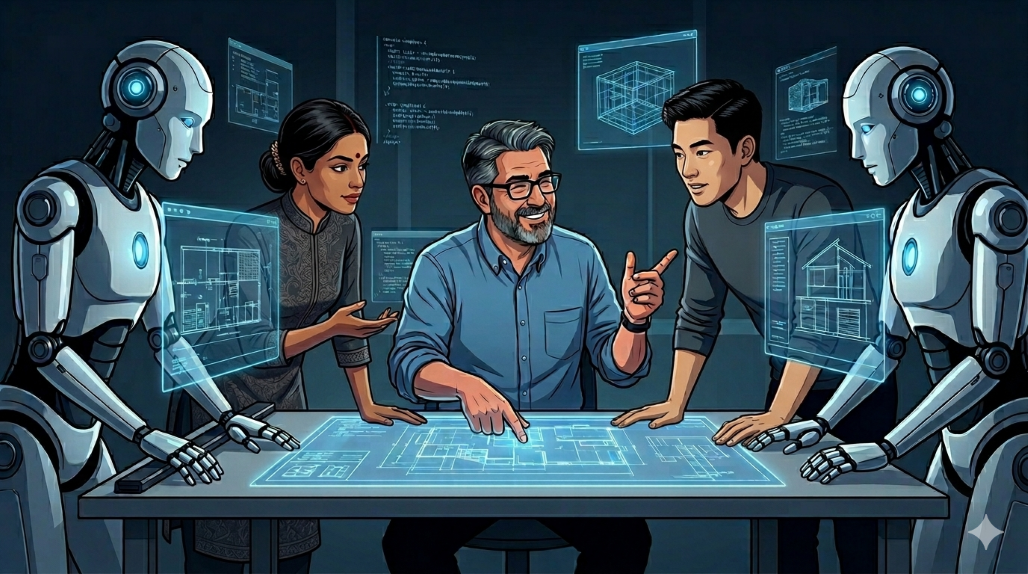
As an architect who still codes, my understanding of SDD is that it is about the spec files that are carefully crafted to direct generative AI in how to write the code. It is a way to get better code from the AI that will require less refactoring after the first results.
The different perspectives made me think it was worth doing a little research and summing it up for my reader here. I admit to mentally vacuuming up a lot of content about AI in order to feed my own synthesis on its use, and the key thing that I saw differently was the ownership of the specification used for SDD.
When I presented the question “Who owns the spec in spec driven development?” to an AI, it responded with “…humans own the spec…”, which points out a whole new perspective.
So, that’s what drove me to dig in a little bit to improve my own understanding and share the results.
A Quick History Lesson
Like most things in IT, the earliest signals appear long before what we later label as “modern” computing (a term that conveniently tends to align with when each of us personally got excited about technology). As far back as 1987, Managing the Development of Large Software Systems: Concepts and Techniques outlined ideas that closely resemble what many now think of as Specification-Driven Development (SDD). Interestingly, its diagrams reflect structures similar to waterfall methodologies (an ironic reminder that many “new” ideas are refinements of older patterns rather than entirely novel inventions).
These concepts did not evolve in isolation. Over the following decades, they were reinforced by related disciplines such as formal methods and API design principles like Design by Contract* (which emphasized precision, verifiability, and clearly defined interfaces). Later, approaches like Behavior-Driven Development (BDD) carried some of this thinking forward, framing specifications as shared artifacts between humans and systems (but still largely as guidance rather than execution).
What has changed more recently is the role of AI in making specifications actionable. Around 2025, tools began to emerge that transformed specs from passive documentation into active drivers of implementation. Projects like AWS Kiro and GitHub’s spec-kit marked a shift. Specifications became executable guides for coding agents (not just references for developers). In this sense, “modern” has continued to compress (moving from spanning decades to evolving almost in real time), as specs shift from descriptive artifacts to operational components of the development process.
Opinions Still Differ
I don’t think my input in the recent conversation changed anyone’s mind about how they define SDD. And people will definitely have strong opinions on the value of SDD.
In a recent post, Allen Holub said:
“People talk about spec-driven design, but the best spec you can have is a test—a test you write before you write the code. You don’t write a test to see if the code adheres to a spec. The test IS the spec. Don’t write specs. Write tests.”
I agree with TDD proponents, because it is part of a Continuous Testing cycle, a process that was just starting to really catch on before GenAI went GA, and is even more important since. That said, tests are part of the spec, they are just managed a little differently because the developer doesn’t happen to be human. That’s the whole point of SDD. It is how developers work with agents through clear communication. Because, let’s face it, the Agile approaches of sitting with a user won’t work with AI until after the code has been written, and pair-programming with an AI was only modern for a moment.
Helpful Tools to Try
Tools make this less painful than it sounds.
GitHub’s spec-kit is a good entry point. It gives you Markdown templates for a “constitution” file with principles, then spec.md, plan.md, tasks.md. You slash-command it in your IDE, and AI fills in the gaps. They put it well: “The specification captures intent clearly, the plan translates it into technical decisions.” ([GitHub Blog], Spec-driven development with AI: Get started with a new open-source toolkit) Amazon’s Kiro does staged workflows, Tessl flips code to byproduct. Red Hat talks up “lessons learned” files to feed back into future specs, cutting errors over time ([Red Hat Developers], How spec-driven development improves AI coding quality).
Wrapping Up
All in all, my sense is to treat specs like your IaC or database schemas. Human owned from the start, iterated carefully, governed with some structure. Reference standards to ground it. Try it small, on a utility script maybe, and see how it holds up in real work.
If it fits your flow, it can add real velocity with AI. If not, no big loss; plenty of paths forward.
*Side note: Yes, I usually have these inline in parenthesis (a habit my AI editors hate), but this one seemed too long for that, so… I did some research with Gemini where it insisted on a correlation between design by contract and spec driven development, which at first I took to mean it prefers its training data rather than current information, so I switched to my usually research LLM wrapper, Perplexity. After some hind-brain thinking, it occurred to me that Gemini may have semantically equated specification with contract, which is another quirk of AI: it is so darn literal!