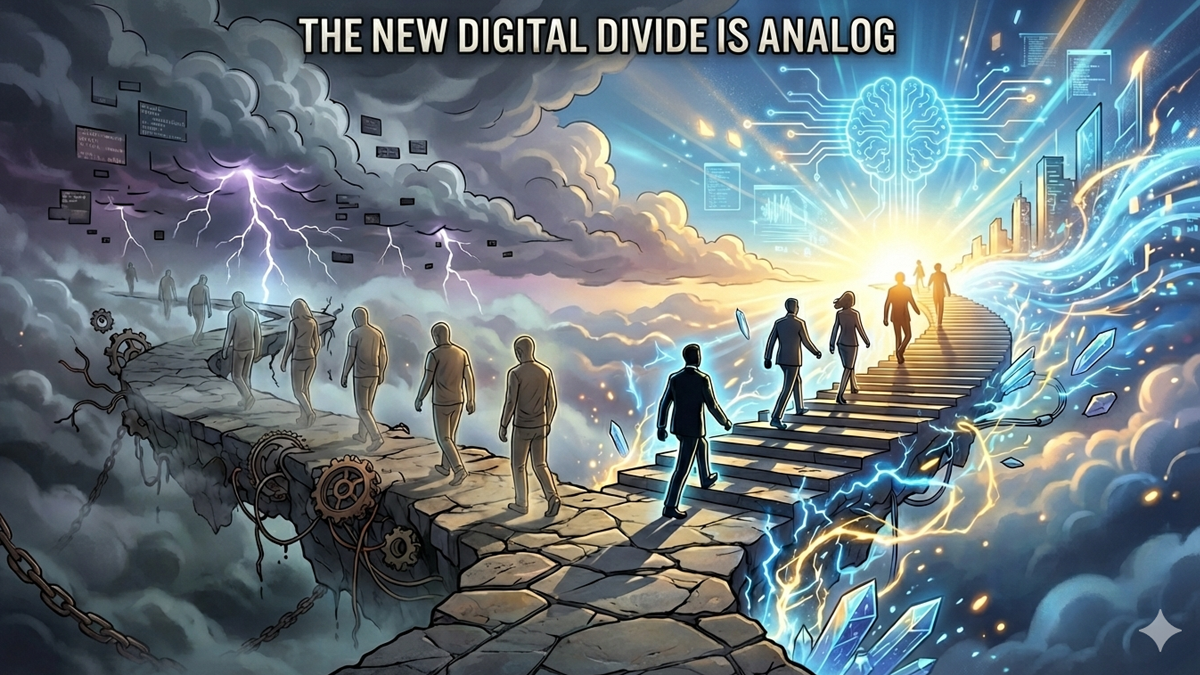
The recent article by CT Crooker, Why Everything You Know is Probably Wrong, is filled with hard truths that everyone in IT needs to consider. It starts by pointing out the evidence supporting the thesis that things are going to be very different.
“Going to be” is the one level where I depart from a lot of recent articles by really brilliant people. When discussing the unprecedented acceleration of new and improved capabilities that come under the media definition of AI, these experts are not only correct in their assessments of the rate of change; they understand the details of those changes better than most.
However, they often present these shifts as a present-tense reality for the masses. For the vast majority of organizations, these changes are still in the “going to be” phase because the experts are focusing on a very active and very small minority.
Then there are people.
-
Most CI pipelines aren’t really continuous and don’t truly integrate.
-
Teams hold stand-ups and manage backlogs that aren’t the least bit Agile.
-
Enterprise CRM systems are treated as glorified address books while the predictive analytics and automation features sit dormant.
-
Smartphones are used for scrolling while the powerful sensors and computing power in our pockets remain largely untouched.
The main impedance to technical solutions is rarely a technical problem. The real culprits are process and culture challenges that act as a silent brake on innovation. This resistance to change usually stems from a deep-seated fear of the unknown or a perceived threat to the status quo.
When a new capability arrives, it doesn’t just offer a faster way to work; it threatens the established hierarchy, the “way we’ve always done it,” and the specialized knowledge that individuals have spent years protecting. These psychological hurdles are the biggest obstacles to adding and improving technical capabilities. It will take significant time before these new tools make it into mainstream IT departments because human behavior does not move at the speed of a GPU.
A Challenge by any Other Name is…Entirely Different
This brings me to the point of my only contention with the article. I disagree with the suggestion that “transformation impedance” is a better way to think about these shifts than “epistemic flexibility under inversion.” While I find the shift in terminology problematic, Crooker’s post is otherwise incredibly thought-provoking and accurate; it is really valuable that he raised these points because they are essential to consider.
He explains “epistemic flexibility under inversion” as a capability characteristic of both systems and people to adapt to rapid changes and then adopt new approaches as a result. He goes on to suggest that “transformation impedance” may be a better way to think about it.
But branding is more important than most realize. People who take up the call of “transformation impedance” will be more likely to focus on the impedance side, which leads to conflicts between those who think everyone should reduce the impedance versus those who want to lower it. I’ll admit there is some room for collaboration on the rate of lowering impedance, but then again, there are still a lot of those CI pipelines that are still neither.
First, I will admit that I had to look up the definition of “epistemic flexibility under inversion” to fully digest it:
“Epistemic flexibility under inversion” is a specialized concept often found at the intersection of Bayesian statistics, cognitive science, and information theory. It refers to a system’s (or a mind’s) ability to maintain a coherent understanding of reality even when the “direction” of information flow or the relationship between cause and effect is flipped.
Once I had this better understanding, I had the same reaction to using “transformation impedance” as an alternative as I do to changing “issue” to “challenge.” (There is a lot more to that definition, of course, and I suggest you talk with your favorite Generative AI LLM to get the rest of the picture.)
The Utility of the Negative
Media tells us we should always be positive and pursue higher goals. We buy into this because the truth is that the method of using the negative to drive action, specifically addressing an “issue,” is much more likely to succeed than the message of chasing a dream. That’s another hard truth.
I like “issue” better than “challenge” because people will deal with an issue so it will go away. A challenge makes them feel good about pursuing it, and since the pursuit is the reward, completing it removes the reward and thus the incentive. If it is an issue, the incentive needs to be to correct it.
While “epistemic flexibility under inversion” may be harder to understand, it keeps the focus on how we need to change our approach to deal with the changes approaching us. “Transformation impedance,” on the other hand, is a label describing a phenomenon and doesn’t necessitate action until it is too late.
We need to flip our approach and find ways to catch up with change and not be left behind or run over. We should begin thinking about what problems need to be solved for our businesses, and even our lives, that for whatever reason we thought were too hard before, and then come up with new solutions taking advantage of the AI. To do that, we must be willing to set aside the old frameworks that impede our ability to do so.
© Scott S. Nelson