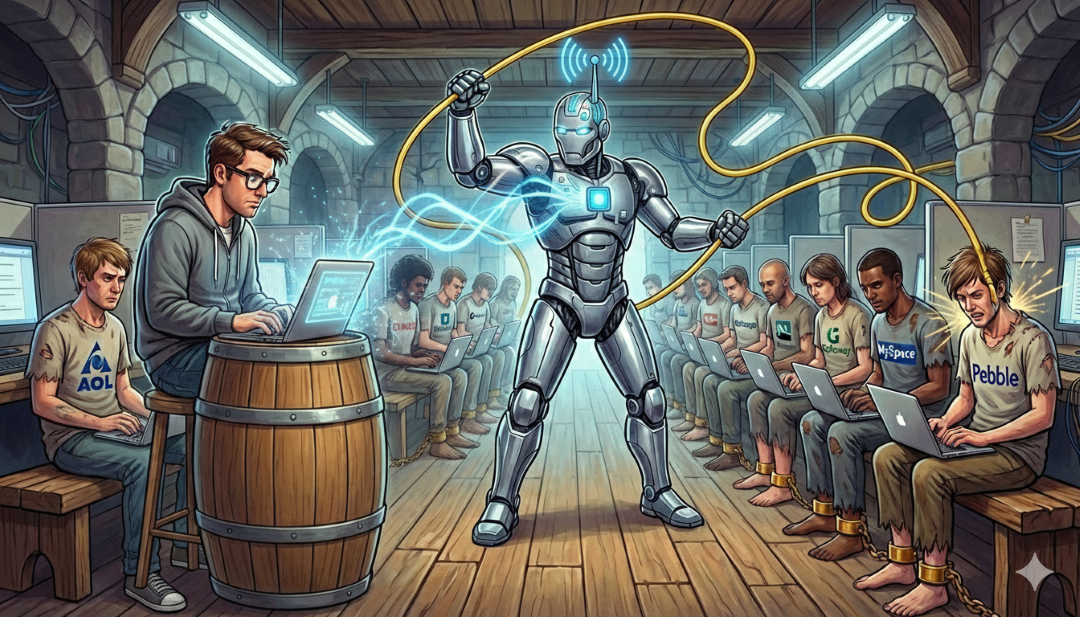
A recent exploration into the “frictionless trap” addressed how taking the easy path can weaken personal abilities and lower the collective capabilities of humanity. This observation did not imply that the opposite, such as excessive and grinding labor, is desirable. A BBC article serves as a stark reminder that in certain sectors, people are working far too much. While this trend has been reported on previously, a Slashdot post providing commentary on that specific article served as the final catalyst for this rant.
The Philosophy of Ease
Under the title of this blog is the statement: Technology should make things easier. The original driver behind my blog was to simplify complex tasks so that a struggle encountered the first time would be much easier the next. My focus was on tasks requiring repetition but occurring too infrequently to become muscle memory, which is a concept similar to the Second Brain framework later branded by Tiago Forte.
Under its original name and domain, my blog caught the eye of an editor at Developer.com. This led to me writing how-to articles on processes that were time-consuming to figure out but simple to execute once all the steps were gathered and sequenced. Generous copyright rules allowed me to republish these pieces after a holding period with proper attribution.
This shifted the focus of my blog toward making things easier for others. The beauty of making a task easier is that it frees people up to spend that time on more productive, interesting, and creative pursuits.
Historical Leverage: The Promise of Progress
History reveals a series of technological leaps designed to trade mechanical effort for human potential. The transition from foraging to settled agriculture allowed humanity to move beyond the daily search for calories. This newfound surplus of time provided the foundation for the birth of philosophy, mathematics, and complex governance.
During the Industrial Revolution, steam and steel began to replace human and animal muscle. Tasks that once required an entire village to complete over several weeks were suddenly finished in mere hours. This shift was theoretically intended to liberate the worker from the most back-breaking forms of labor.
By the 20th century, the “electric servant” arrived in the form of home appliances. Washing machines, vacuums, and ovens were marketed as the ultimate liberators of the domestic sphere. These tools promised to turn hours of physical toil into the simple push of a button, reclaiming life from routine chores.
The digital age followed with the promise of the paperless office and instant data processing via computers. Spreadsheets replaced rooms full of ledger-keepers, and word processors eliminated the need to re-type entire manuscripts. In every era, the pitch remained the same: efficiency would set the individual free.
The Darker Side: The Persistence of Burden
Despite these advances, the time saved has often been redirected into new forms of systemic entrapment. The agricultural revolution, while providing stability, was frequently accompanied by the rise of feudalism and organized slavery. In these systems, the efficiency of the land was not used to grant leisure to the tiller but to consolidate power and wealth for the few at the top.
The industrial era followed a similar pattern of redirected effort. Rather than creating a world of leisure, the introduction of the machine often birthed the sweat shop. Workers were required to labor for 16 hours a day in dangerous conditions just to maximize the output of the new technology. In the modern consumer age, this burden evolved into planned obsolescence, forcing individuals to work longer hours simply to maintain or replace items intentionally designed to fail.
Today, the digital version of this burden has manifested as the 72-hour work week. The efficiency of the computer has not actually shortened the workday for many; instead, it has been used to increase the speed and incline of the productivity treadmill. We have built tools that cut effort ten-fold, but the saved time is often swallowed by a demand for even higher volumes of output.
The Modern Silver Bullet
The conversation around these saved hours has reached a fever pitch with the advent of AI. A recent discussion explores the idea that we may finally have a “silver bullet” for software development. This technology attacks both accidental complexity (the mechanics of coding) and essential complexity (the logic of what to build) by leveraging decades of established patterns. However, the warning remains: while the silver bullet exists, the real bottleneck is no longer the code, but the management. If leadership fails to aim this tool correctly, the result is not liberation, but a “heck of a kick” that could lead to catastrophic failure or even more grueling hours for those involved.
Breaking the Cycle of Diminished Returns
There is no inherent opposition to working hard or putting in long hours. However, there is a strong stance against working to the point of diminished returns. This occurs when the final 42 hours of a marathon week produce less value than the first 30.
There is a fundamental lack of logic in developing a tool that cuts effort ten-fold only to use it 15 times as much rather than using the saved time to improve the lives of people. For business leaders, the goal should be to divide saved resources between improving work-life balance and enhancing the capabilities of the organization.
Working smarter on interesting tasks produces results far superior to grinding for the sake of volume. Technology can improve shareholder value without requiring the sacrifice of human well-being at the altar of effort.
The Question for Leadership: Is accelerating the ROI of AI initiatives worth the cost of driving people to work twice as much?
© Scott S. Nelson