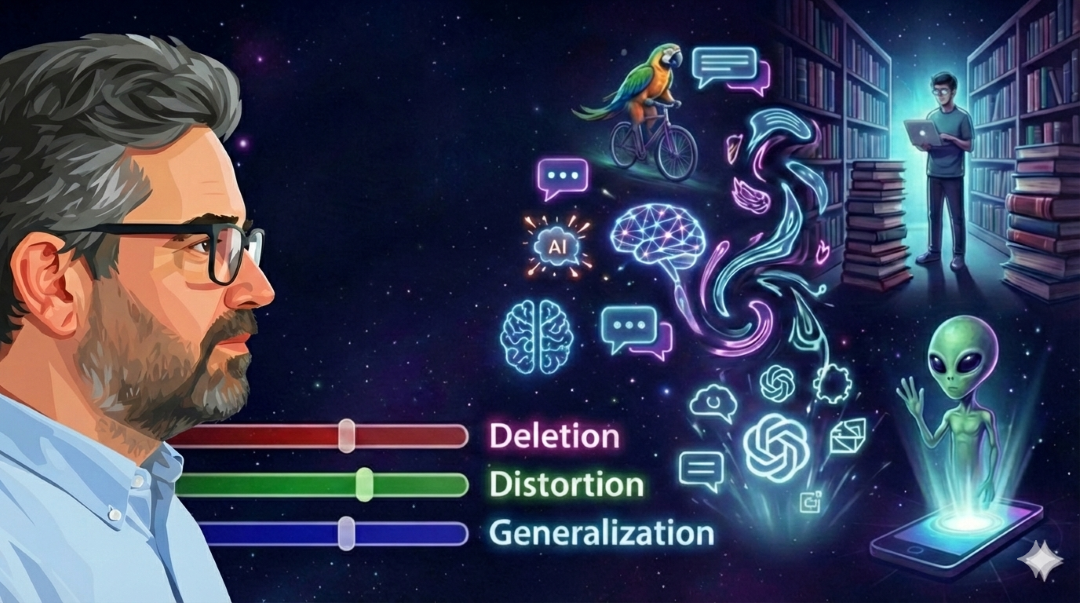
That headline is an epic fail at being clever. Clearly no AI there. Going to go with it anyway to make a point or two.
Human perception is just a collection of filters. Adjusting for “Red,
Green, and Blue” in an image is no different than how our brains handle
new tech through Deletion, Distortion, and Generalization.
The AI hype bubble is the ultimate stress test for these filters.
Human Perception as
Filtering
The first point is, human perception is the result of filtering.
Actually, all perception is the result of filtering; it is just that
humans are more interested in how it affects them. That is actually part
of the filter.
Sort of like image filters, where you have adjustments for Red,
Green, and Blue, perception is adjusted through deletion, distortion,
and generalization. Some examples:
- Deletion: Everyone has at least one thing they do
where they wouldn’t do it if they remembered how difficult it was. - Distortion: Media algorithms that zoom in or out
based on audience bias. - Generalization: The core of most learning and both
a boon and barrier to that very learning.
While generalization is core to individual learning, all three
filters can be seen when groups of people are learning. Here is how
those filters are dialed at a group level:
- Deletion: Things we learned in the past that would
help us better adopt and adapt to what is a new paradigm in
technology. - Distortion: Knowledge distribution through media
algorithms that zoom in or out based on audience bias. - Generalization: Comparing new paradigms to
previously familiar concepts; being exposed to high-level concepts as
parallels to common knowledge to build on iteratively, going deeper each
time.
The AI hype bubble is a perfect example of the above perceptual
filter settings.
Metaphors for AI Perception
Taking this back to the headline, an anadrome of LLM, here are five
common metaphors being applied to AI (and organized by AI, TBH) that are
worth adding to your own perceptual filters:
- The “Alien Intelligence” This metaphor suggests
that AI doesn’t think like a human; it is a powerful, non-human mind
that we are trying to communicate with. It highlights the “otherness”
and unpredictability of Large Language Models (LLMs). Best
for: Discussing AI safety, alignment, or the surprising ways AI
solves problems. Source: Popularized by technologist
and writer Kevin Kelly in Wired, where he argues we should view AI as an
“artificial alien” rather than a human-like mind. - The “Stochastic Parrot” This is a more critical
metaphor used to describe LLMs. It suggests that AI doesn’t “know”
anything; it simply repeats patterns of language it has seen before,
much like a parrot mimics sounds without understanding the meaning.
Best for: Explaining how LLMs work, discussing
hallucinations, or tempering over-hyped expectations.
Source: From the influential 2021 research paper “On
the Dangers of Stochastic Parrots,” co-authored by Emily M. Bender and
Timnit Gebru. - The “Bicycle for the Mind” Originally used by
Steve Jobs to describe the personal computer, this metaphor has been
reclaimed for AI. It positions AI as a tool that doesn’t replace the
human, but rather amplifies our natural capabilities, allowing us to go
“further and faster.” Best for: Productivity-focused
content, tutorials, and “AI-as-a-copilot” narratives.
Source: Originally Steve Jobs (referring to PCs);
recently applied to AI by figures like Sam Altman (OpenAI CEO) in
various interviews regarding human-AI collaboration. - The “Infinite Intern” This metaphor frames AI as
a highly capable, tireless assistant that is eager to please but lacks
common sense and requires very specific instructions (prompting) to get
things right. Best for: Business use cases, delegation,
and explaining the importance of “human-in-the-loop” workflows.
Source: Widely attributed to Ethan Mollick, a Wharton
professor and leading voice on AI implementation in education and
workplace settings. - The “Electric Library” Think of AI not as a
search engine that gives you a list of links, but as a librarian who has
read every book in the world and can synthesize that information into a
single answer for you. Best for: Explaining the shift
from traditional search to Generative AI search.
Source: A common conceptual framework used by Ben
Evans, a prominent technology analyst, to describe the shift in how we
access and process information.
However you perceive the rise of LLM-based AI, include “Springboard”
in your own collection of metaphors. That is, something that helps
anyone reach higher when approached at high speed with focus…and will
trip you if you come at it the wrong way, even at a slow walk if not
paying attention.
This post was inspired by a post on LinkedIn by Dr. Thomas R. Glück. If
you have read this far, please like, comment on, and share both.
If you get all the way through this post, please
tell me if the “MML” headline is an epic fail at being clever or if it
caught your eye. (Full disclosure: I use a Gem to review and edit my posts, and
generally ignore 80% of what it suggests, including losing that
headline.)
© Scott S. Nelson